

 Apple Podcasts
 PocketCasts
 Spotify
 Overcast
 TuneIn
 RSS Feed
 YouTube
 Amazon Music
 Microplastics, CCL 6 and EPA Drinking Water Policy with Megan Quinn of Waste Dive
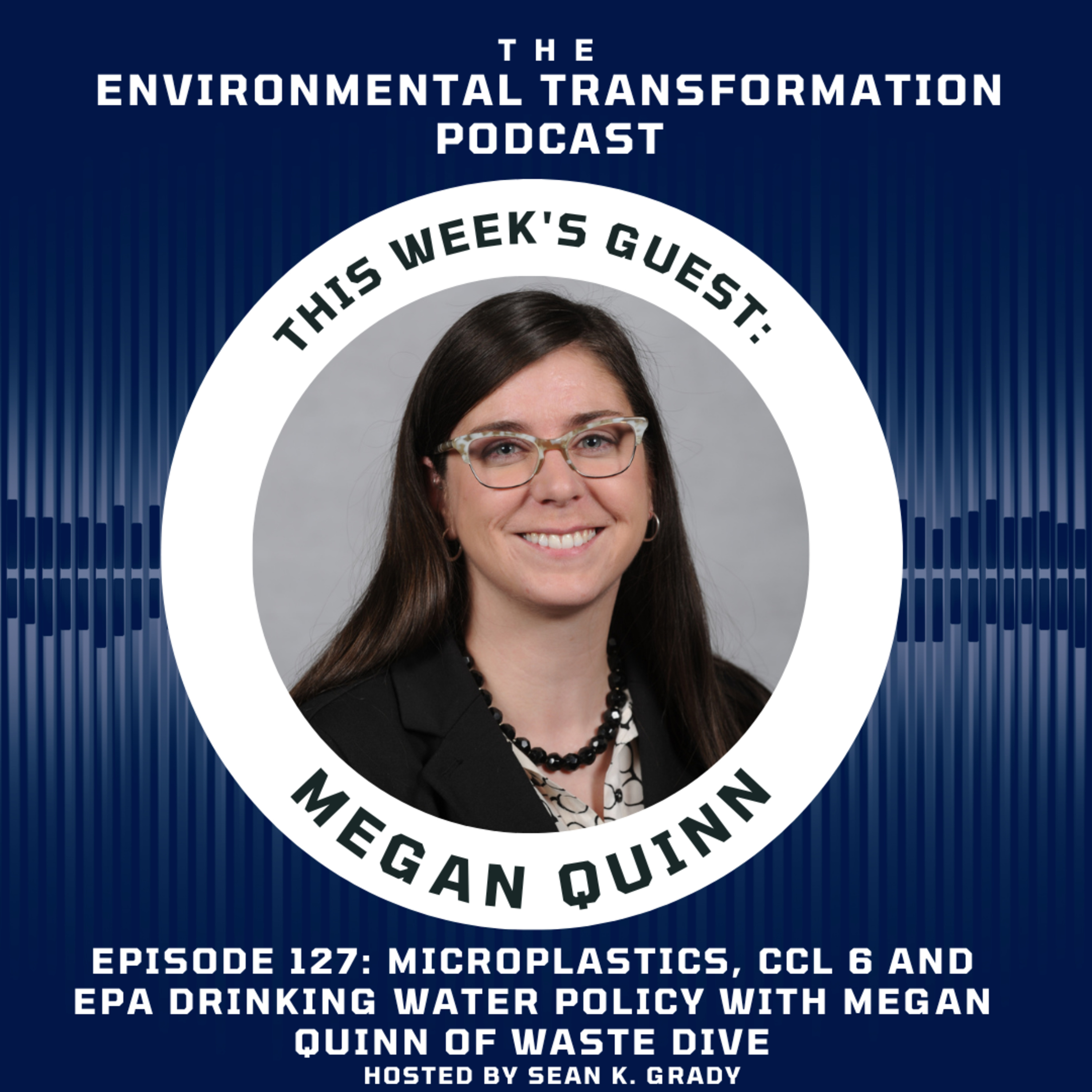
Microplastics appear on a federal contaminant watchlist for the first time, and the regulatory path forward remains far from certain. Megan Quinn, senior reporter at Waste Dive, breaks down what the EPA's proposed new Contaminant Candidate List 6 actually means for water utilities, landfill operators, and chemical manufacturers, and why the lack of standardized test methods could slow any future regulation significantly.
Quinn explains how the CCL process works, who sits on the newly reshuffled Science Advisory Board, and why the parallel push from the MAHA movement adds political complexity to what is otherwise a science-driven process. The conversation draws on direct parallels to how PFAS moved through the regulatory pipeline over more than a decade, from early CCL listings to drinking water standards to hazardous substance designations, offering a framework for understanding how microplastics and newly listed pharmaceuticals might follow a similar, lengthy trajectory.
The episode also covers the dissolution of the EPA's Office of Research and Development, New Mexico's move to regulate PFAS as a hazardous waste, the Department of Defense's updated PFAS destruction and disposal guidance, and what the rollback of certain PFAS drinking water standards signals about the current administration's regulatory priorities. The public comment period for the draft CCL 6 closes June 5, 2026.
Megan Quinn covers state and federal recycling policy, PFAS, chemical recycling, environmental justice, and EPA regulatory changes for Waste Dive.
0:00 Introduction and Megan Quinn's Background
1:55 What Is the Contaminant Candidate List 6
5:00 Public Comment Period and Finalization Timeline
6:45 Science Advisory Board Changes Under Trump
8:45 Who Is Affected by CCL 6
10:30 Should Companies Begin Sampling Now
13:00 Lack of Analytical Methods for Microplastics
15:10 EPA Research Capacity and Budget Cuts
17:30 Private Industry's Role in Federal Research
19:15 Public Concerns and Red Flags
21:00 PFAS as a Regulatory Roadmap for Microplastics
25:45 How Waste Dive Covers EPA Announcements
28:00 New Mexico PFAS Rules and PFAS Incineration
30:15 Advice for Stakeholders Watching CCL 6
33:30 Who Is Monitoring for Microplastics Now
34:30 Closing Remarks
Unknown Speaker (0:00): We know that microplastics are bad for us, but we just don't know exactly how
Unknown Speaker (0:05): bad
Unknown Speaker (0:05): they So both of these agencies have really made a you know, they've been talking a lot about how they really want to invest in that research, and that is why these items get put on the CCL.
Unknown Speaker (0:17): Welcome to the Environmental Transformation Podcast, where we bring you interviews with industry leaders, climate champions, sustainability practitioners, EHS and hazmat professionals, making an impact in their businesses today. Each leader solving complex challenges and delivering solutions within their areas of expertise. I'm your host, Sean Grady, and thanks for joining us today. Before we jump in, make sure to follow us on your devices and visit my website at www.seankgrady.com and sign up for our newsletter and email announcements. Now let's get started.
Sean Grady (0:50): Welcome to the Environmental Transformation Podcast. I'm your host, Sean Grady. Today's guest is Megan Quinn. Megan, she is a senior reporter for Waste Dive and has been covering the waste and recycling industry for over a decade. Her beats include state and federal recycling policy, PFAS, chemical recycling, environmental justice, and EPA regulatory changes.
Unknown Speaker (1:12): She lives in the Washington DC area, and we're excited to have her on the show. Welcome, Megan.
Unknown Speaker (1:17): Thanks for having me.
Sean Grady (1:19): You guys put out a little piece on the new contaminant candidate list, the CCL six list. Sorry about that. I was trying to spit that out.
Unknown Speaker (1:28): A lot of acronyms in the EPA, yeah.
Sean Grady (1:30): I know, right? There's so much coming out of the EPA right now, but, you know, as I read the new list, and the discussions around it, I thought, wow, this is interesting. You guys have a good take on it, I thought, let's get together and talk about this. So, to the show, let's dive in here. Yeah.
Sean Grady (1:49): Tell us a little bit about your role there at Waste Dive before we do so we can kinda get a flavor for what you're covering, how you're, you know, what's important to you guys at Waste Dive and what the industry response has been.
Megan Quinn (2:01): Yeah, so I'm a senior reporter for Waste Dive. A big part of what I cover is happenings in the EPA, particularly how the those things are gonna relate to, waste and landfill operators. So anytime the EPA makes a decision, talks about making a decision, publishes something new on a list like we'll talk about today, you know, our readers wonder how that's gonna affect them. And, typically, when I'm covering EPA related, regulations, a lot of times it's related to PFAS. So I'll probably talk about that a lot today because there are some parallels even though microplastics and pharmaceuticals are not the same as TFOS, but there are some parallels in terms of how EPA is kind of starting to talk about them.
Unknown Speaker (2:43): Yeah. That's right. Yeah. It's a good point. There are a lot of parallels with that.
Sean Grady (2:49): With the EPA recently proposing this new CCL six, it is kind of a big deal in the industry. And if we look at this, the list includes microplastics, which is a big deal I think in the industry because now they're really wanting to figure out how bad or what impact do microplastics have on the human body. Which is I think a good thing. Also, they're gonna also look at additional pharmaceuticals on the list for the first time. In your view, why is this a watershed moment for Safe Drinking Water Act and what does it tell us about the EPA's current priorities?
Megan Quinn (3:24): Well, think this is really interesting because as you said, so this is the first time microplastics and pharmaceuticals are included on this CCL. So the contaminant candidate list, just to back up a little bit, this is a list that the EPA has to publish every so often. I believe it's every three to five years.
Unknown Speaker (3:42): I'm I should
Megan Quinn (3:43): I don't know exactly, but it's it's a pretty, it it's pretty common that we'll we'll see additions to this list. But what this list is, it's not a regulation. It's just a sort of sim signal that the EPA is going to be looking into these materials more closely and getting more research into them because, these items on this list might eventually be regulated. But nothing on the CCL is a regulation itself. But to go back to your original question, you know, adding microplastics is really interesting because, we are seeing, you know, people really concerned about what microplastics might be doing to our bodies.
Megan Quinn (4:21): And the EPA specifically, when they made this announcement, they made it alongside, you know, the the MAHA movement, the Make America Healthy Again movement, because, that agency is doing some parallel research into microplastics. And the two agencies together are really trying to deliver this united front and say, hey. We need to do more research on microplastics and how they're affecting human health. We're gonna do it together in some different ways and that might end up signaling some future regulations. But those things take quite a long time.
Megan Quinn (4:55): Know? Yeah. You know, federal regulations take a long time, and adding this to the list is really just that first initial step.
Sean Grady (5:04): Yeah, I mean, so right now they've published the list of chemicals and there is a public comment period opening that closes 06/05/2026. So right now the EPA's got the published list of priority contaminants out there that they're wanting to focus on. They wanna get more science based information so they can kinda make better decisions. They say that they're gonna finalize the list in November, on the November 17 in 2026, and then that'll kinda like basically, I guess, move it towards the UCMR program, I believe, is kinda at some point what that'll end up happening, but and then they'll figure out where they're gonna go with the various chemicals that they wanna list. For those unfamiliar with this process, what now has to happen with this draft?
Sean Grady (5:53): I mean, we've got this, are we wait, we're just gonna be waiting to hear and you know, walk us through maybe some of the journey of this substance takes to go through this process before it's actually regulated?
Unknown Speaker (6:05): Yeah, it's a bit of a, I wanna say it's a mystery, but because, you know, there are so many items on this list and not all of those do end up becoming regulated in certain ways. It's not clear, like, which ones actually end up becoming part of a regulation later on. Yeah. One thing that, like you mentioned, so EPA does have to go through public comment period. This is just a sixty day period.
Megan Quinn (6:27): So they're really asking people to get in quick and get those comments in.
Unknown Speaker (6:31): Yeah. That's pretty sure.
Megan Quinn (6:33): Yeah. And and another thing, I don't always notice EPA, saying a specific day that they plan to, release regulations. So I think that's also interesting. To me, that kinda signals that they're pretty serious about just, getting this going. But one other thing they have to do is, they do have to run it through their it's an independent science advisory board, before finalizing that list.
Megan Quinn (6:57): The science advisory board is made up of a bunch of different individuals with different backgrounds who take this independent lens. And this is something that has been around for a long time. But one one interesting note is that that board was completely reset when the Trump administration came into office for the second time. So everybody who was I think almost everybody who was on that board ended up leaving were asked to leave. And we do see this happen when there's administration changes.
Megan Quinn (7:24): I know that during the Biden administration, they did reshuffle a few people on that board. But on, just last week, they, the administration announced who is gonna be the next people on this science board, which I think might give us an indication on what kind of lens some of these chemicals are gonna take because some of the the people who have been added to this board include people, who used to work for Dow, Kimours, DuPont, things like that. So we're really seeing that kind of shift towards maybe a more industry focused advisory panel. So all that to say that there's a lot been a lot of changes in the EPA, obviously, from the time that the Trump administration took office again. So that's it's a little unclear sort of what the next steps are other than the steps that the EPA has already said.
Megan Quinn (8:09): So public comment period, they're expecting to potentially sign this and and make this official by November and go through this advisory period in the meantime. And I think where it's gonna be interesting to see sort of like what happens in the meantime. So
Sean Grady (8:25): Yeah. Yeah. It's gonna be interesting to see what that advisory board does with the review process when when these chemicals are finalized after November. How do they make it to the next level of the review process? When we talk about who is affected by the CCL six list, Is this strictly a headache for municipal wastewater or municipal water utilities or or should private industry really be looking over their shoulder too?
Megan Quinn (8:54): I think we saw in the case of, the last time PFAS were included on the CCLs that any industry that is even like remotely related will be taking notice of the CCL. And again, this is just the draft CCL six, so nothing set in stone. But, you know, I think public water systems are obviously they pay close attention to this list. I looking at some, other analysts and what they had to say about, who they think is most affected, it's pretty some pretty standard folks. Right?
Megan Quinn (9:27): Like, folks who work in, you know, chemical manufacturing, anybody who works in pharmaceutical manufacturing, are probably just gonna be paying attention to this. And but I do think that public water systems are are probably like the main the main target audience. And for our audience, you know, in the waste and recycling industry, we take note of this list because, you know, anytime there is eventual regulations for drinking water, you know, the like, landfill operators care about that because their leachate goes to water treatment systems. So they wanna know, hey, is there something I need to be doing in the interim? Is there gonna be a situation where I'm gonna have to change what I do or change my relationship with the water treatment systems?
Megan Quinn (10:05): So specifically from a waste industry, even though the CCL doesn't really, like, directly apply to our industry, it definitely signals things to watch out for in conversations that maybe waste operators are gonna be having with water treatment systems down the line.
Sean Grady (10:22): Yeah, absolutely. I mean, it's definitely now put, you know, these contaminants or these potential contaminants on their radar. I guess the big question would be for a company is, should we sample? You know, what is the expectation? My understanding, this isn't a regulation that's requiring somebody to sample.
Sean Grady (10:41): So that's one thing, but should companies be beginning, should they begin sampling for these contaminants now or is it too premature to invest in any of the monitoring of this before the list is finalized?
Megan Quinn (10:52): Yeah, I think that's always the question that affected industries have when they start hearing about potential regulations. We did see like down couple years ago when the waste industry was getting wind that certain PFAS might be regulated. Not in CCL, five, though there are there were PFAS in c c CCL five, but some of those PFAS ended up being regulated as a separate regulation for, you know, drinking water standards and also two PFAS were regulated as hazardous substances, though both of those things are going through a court process right now. So those are up in the air. But, when the industry was getting wins that those might be regulated, that was a big question.
Megan Quinn (11:36): Right? Like, do we what do we do now? Like, are we waiting and seeing for there to be a final regulation before we spend money? Do we wanna get ahead of the curve? And we did see in the waste industry companies taking both tack and deciding some decided, like, yeah, we're gonna just see which way the wind blows.
Megan Quinn (11:53): Others were investing or partnering with PFAS management companies to, you know, just kinda get ahead of it. Also, because there's also state regulations that are that happened way before some of these federal regulations. And I think we're also gonna see that with some of the new materials on the CCL six like microplastics. However, one thing I just did wanna mention too, when I was at the EPA for this announcement a couple weeks ago, Jessica Kramer, who's the the she's the assistant administrator for the office of water at the EPA. She had made a comment that, you know, the CCL is not regulation, like we said, but she had kind of framed it as the idea that there's these proposed benchmarks that can come out of it.
Megan Quinn (12:33): And those might be some sort of like, just ways for industry specifically, you know, water treatment facilities to kind of, get some waypoints of what they might want to monitor down the line. So that it's there's no clear answer, I guess. Yeah. No clear answer with a lot of these things. But I think we've we've seen in the case of PFAS, the industry kind of doing, you know, a couple different things to sort of prepare.
Megan Quinn (12:57): But, know, the EPA has not told industry, hey, you gotta start monitoring this or hey, you gotta start or or even like what to measure, right? There's no metrics for a lot of these things that are on the proposed CCL six. Like there's no big there's no big metrics for microplastics, for example.
Sean Grady (13:13): I think the big issue that will be for a lot of companies who are maybe interested in learning if they actually have microplastics and then some of these other pharmaceuticals in their waste streams, would be that there's not really a good solid standard analytical method yet. I mean, that's the big thing that the laboratory industry side of the house with this new proposed CCL six list is they need to develop really solid test methods like PFAS, when it came out, they were struggling to come up with really solid analytical repeatable methods before it could be standardized for companies to use. And now that they have those, it's more, you know, adopt everyone's adopted those methods. But I don't think that's ready to go yet for some of these parameters. Right?
Megan Quinn (14:02): Yeah. As from my understanding, and, you know, microplastics is not really something I I cover super Yes. Like compared to like something like PFAS. But to your point, I mean, I think because there's just not really there's not a lot out there to point to. There's no yardstick really right now.
Megan Quinn (14:19): And that is something that I think some, you know, environmental groups have also brought up as being kind of a a criticism, and something that they wanna see more of. And also a lot of these, health groups that have been kind of influencing the direction that, you know, the Maha movement is going where they're all saying like, hey. We know that microplastics are bad for us, but we just don't know exactly how bad they are. And, you know, so both of these agencies have really made a you know, they've been talking a lot about how they really want to invest in that research, and that is why these items get put on the CCL because the CCL is sort of this indication of what kind of time and resources, these agency well, specifically the EPA is gonna put into that research because there needs to be more research before you can come up with, you know, metrics and methods.
Sean Grady (15:12): Yeah. Yeah. Well, just to kinda look at how the agency's approaching this, know, in MAHA, I gotta commend them, I mean, they are actually trying to address some contaminants that are a bit of a concern or now that are being raised a concern and they're saying, look, industry, we don't have enough science. We need to study it. We need to figure it out.
Sean Grady (15:31): Let's do this. This is the process. That's good, I think. Right?
Megan Quinn (15:35): Yeah. One thing I would say to that also, so because I'm sitting, you know, when I was at the EPA, I was sitting there hearing all these presentations from these scientists that are saying like, here's what we're working on, here's what we wanna work on. You know, the the federal government is putting quite a bit of time and money into this. However, there's also a lot has been happening at the EPA in the last year and one of the things that happened was the main research office for the EPA was was disbanded. And a lot of the people working in that research office either ended up in other parts of the agency or potentially were laid off.
Megan Quinn (16:09): And, you know, the EPA right now is operating with a a very small, yeah, like, amount of people compared to the last couple years. So I think another criticism that we are seeing again, this is mainly from environmental groups, which are saying like, it's great that the EPA is saying that they wanna, you know, monitor microplastics. Like, that's wonderful. However, they're they eliminated the office of research and development, and that seems to be, like, working in direct you know, is not working in alignment with. So, I mean, depending on I think that's that's gonna be interesting to see sort of what happens, you know, what kind of time and resources are are put into that research, especially because and and, you know, also speaking from a a you know, another side of this, EPA last year, rolled back drinking water standards for certain PFAS.
Unknown Speaker (17:00): So They did.
Sean Grady (17:01): They did. So there's that concern. I I don't disagree. There was that concern. And maybe maybe they're thinking along the lines of, and I don't know this yet, but we need probably confirm this, and some investigative reporting could help.
Sean Grady (17:12): But, know, maybe they're going to be outsourcing, you know, to third party some of this research instead of doing it in house, where you've got industry doing the research, probably a little more technically advanced than the EPA. I'm just thinking out loud, I could be wrong, but I feel like there's some good possibility there that maybe the speed of effort too could could work. I don't know, but let's take a look at that because maybe that's how they're gonna kinda solve the problem a little bit.
Unknown Speaker (17:40): Yeah. That that's actually a great that's a really interesting point. If you if you hear of any federal agencies working with private industry on that, let me know. I mean, that wouldn't be unheard of. Right now, we're seeing like the DOD, for example, a lot of their big, like, efforts for battery recycling, for example.
Megan Quinn (17:58): This is not the same thing, but just as an example, you know, the DOD has said like, hey, we want to work with private industry. Like, it's accelerating sort of what we can get out of it. Here's some money. Please do some research for us. And we have seen EPA work with, you know, private companies, public companies on research specifically for PFAS, for example,
Unknown Speaker (18:18): or just like, hey, like 30 was a huge that they've invested millions into that Yeah.
Unknown Speaker (18:24): So this is definitely this wouldn't be a radical
Unknown Speaker (18:27): Right.
Megan Quinn (18:27): Path. But yeah. And and also because the the Trump administration has really said like, hey, we're very pro business. We really wanna, work with more businesses.
Sean Grady (18:37): Might be just different way of skinning the cat, so to speak, but outside the norms of the traditional government process. So I mean, just the thought, I don't know, but maybe that's how they're thinking about doing it. I think when you look at the concern about this, are there any particular challenges or red flags that maybe publics are raising concerns about? Anything there that you've heard so far?
Megan Quinn (19:04): Yeah. I think so I I went to go to this the public comment space just to see if EPA had uploaded any public comments yet for this. And I didn't see any that had been uploaded but that is actually a great resource for anybody to look at if you're wondering, you know, what people are saying, directly to the the agency about these proposed, this wouldn't be regular I almost said proposed regulation. The CCL is not a regulation. Yeah.
Megan Quinn (19:31): None have been uploaded currently, but, you know, just, talking to some folks, talking to different sources and things about what either some concerns are or just what they're looking for. And it kinda goes back to some of the things that we've been talking about already about, okay, so we wanna potentially further regulate some of these materials down the line. Like, do we even go about doing that? What's the plan? I think also because like we had have mentioned before, it's not always clear what sort of has one item from the CCL rise to the top and kind of end up becoming a different regulatory path.
Megan Quinn (20:10): Though the I mean, the EPA has said, you know, there's a combination of different they need, you know, certain amount of research and you know, science involved before they can really like build that path. So I think there's just because microplastics for example are such a new frontier and there's just so there's so much we don't know. And I think that maybe it's not a red flag necessarily, but when I'm talking to sources about this, I think that's a big question that folks have of, okay, like, this seems good. It seems good that it's on this list. It seems good that it's on EPA's radar and, you know, but what And
Sean Grady (20:47): it takes time to get these chemicals listed. I mean, so for instance, if we go back to, you know, with the history of PFOS, PFOS, PFOS, I think it was initially listed on the CCL three back in 2009. And then it was reissued or added again with additional parameters in 2019, I believe on the next CCL or the, yeah, the CCL five. So, I mean, does take a while, and then of course obviously it became part of the UCMR five sampling efforts, which is where the EPA were able to get a lot more scientific data on the pervasity of PFAS throughout the drinking water utility systems. So I think that was interesting and so it's gonna take some time, microplastics may not be just like immediately added to the UCMR six list just because it's here, but it is interesting that it's there, there needs to be some analytical test methods that are developed, are reliable, repeatable, it's a different type of test.
Sean Grady (21:53): I'm sure there's gonna be some interesting conversations with some of the analytical laboratories that are in the industry. I could think of Eurofence, PACE, Enthalpy, you know, there's a handful of them like that, that we'll have, I'm sure a position on this, and maybe they'll be on the show in the next months or so. Cause I think that'll be a good conversation.
Unknown Speaker (22:12): Let me know when that happens. I'll listen in because that's an area that I don't know a lot about. And you know, I think like we've seen with, I don't know this. So this is a little bit of a speculation on my part, but because we don't know, so there's so much we don't know about microplastics. And this came up in at the EPA announcement too that, there's so much we don't know about microplastics to the point where there might be a a case where different types of microplastics might be regulated different ways if there does end up being a regulation down the line.
Megan Quinn (22:40): That's that was something that that came up when folks were speaking at the EPA a couple weeks ago. And we I mean, we saw that and we see that with PFAS too where, like, the more we learn about all the different PFAS chemicals, we are already seeing them be treated differently in regulations and also in the CCL. So, yeah. I mean, there we might be getting more and more in the weeds as we go, and I think that might just be a sign of, you know, having more information. But, yeah.
Sean Grady (23:07): Hello, ET nation. I wanna thank you for listening to the podcast. If you're enjoying the interviews we bring you, consider supporting the program by visiting my website at seankgrady.com and buy me a cup of coffee. Proceeds will go towards helping me continue producing timely content and offset production costs. I'd also like to take a moment and recognize a few of our sponsors of the show who have been amazing partners and our ET nation legends.
Sean Grady (23:32): If you're looking for a drilling and environmental contracting firm to help you delineate the extent of contamination at your site, then look no further than Cascade Environmental. Cascade has over 37 offices across the country and offers a huge range of environmental and geotechnical drilling, site characterization, and remediation services. With their huge fleet of equipment, nationwide coverage, Cascade is a great choice to support your environmental and infrastructure needs. To learn more, check out their website at cascade-env.com. That's cascade-env.com.
Sean Grady (24:08): Hey, are you looking for an equipment rental company to help you with your next wastewater remediation or waste management project? E Tank is the only environmental equipment rental company in the industry that offers 100% guaranteed certified clean temporary liquid storage tanks at no additional cost. This protocol gives peace of mind for the previous customer by limiting their downstream liability as well as the future customer by preventing any cross contamination for all of their rental tanks. E Tank also runs a one of a kind complete maintenance program for all rental items including liquid tight roll off containers, fluid transfer pumps, and filtration items. The next time you are presented with an environmental challenge, call eTank to come up with the solution for your problem.
Sean Grady (25:00): I wanna thank one of our sponsors, WasteLink. WasteLink is the all in one software platform transforming how environmental professionals manage waste, connecting generators, providers, and disposal facilities in a way that is simple, connected, and transparent. Their platform helps streamline everything from waste profiling and routing to inventory management and billing, giving you the tools you need to operate more efficiently and reduce cost. Whether you're a generator looking for better options or a service provider seeking greater efficiency, WasteLink has you covered. If you're ready to take control of your waste management processes and optimize your business, visit wastelink.com to schedule a demo today.
Sean Grady (25:45): So how do, how does these types of EPA announcements, and there's been a flurry of these announcements in the past, this past year so far. I mean, starting from January to now, there's been a number of announcements. How does an outlet like Wastedive respond and cover, figure out what's important? I mean, there's a lot going on, it seems like, happening. You're right there in DC too.
Sean Grady (26:10): Right? You're at the epicenter. You can go to the meetings if you need to. Right? Talk us a little bit about that process for you guys and what you're focused on.
Megan Quinn (26:18): I think with DPA, obviously, you know, they're the top in the federal level. Right? So I think anytime we get so many announcements from EPA and I'm reading through them, talking to people. And, you know, my first question is always, hey. Does this apply to the waste industry in some way?
Megan Quinn (26:38): Or if it doesn't directly apply, how might it apply to their partners or some other regulations that might end up kind of building into the ecosystem of the waste industry because the waste industry is obviously highly regulated. And at the same time, it's like from day to like from day to day, if you're a landfill operator, like you have a lot going on besides like just checking to see what the EPA is doing. In fact, you might actually be more concerned with what's happening on a state or federal level. So that's something that that I try to track too. And yeah, so there's there's a lot.
Megan Quinn (27:11): Yes, there's a lot going on. Think, right now, obviously, drinking water standards are are top of mind because of this conversation. But, you know, there's also air emission standards that, my my colleague Jacob Wallace covers and he's really a good resource for any type of EPA decision on air emissions, which we're also seeing at the state level are gonna be certain states have, you know, tighter air emissions as well. So we got the air. We got the water.
Megan Quinn (27:40): Anything that's coming out of the leachate. Anything that's coming out of the top of a pile. And I mean, I'm focusing on landfills for the sake of this kind of part of the conversation, but, you know, we also cover, recycling facilities and, organics facilities. Incinerators. Incinerators.
Unknown Speaker (27:58): Yeah.
Sean Grady (27:59): Yeah. Right. The the the DOW just released their new waste guidance, lifting the ban of PFOS incineration, which was a big deal.
Unknown Speaker (28:07): Yes. Yeah.
Sean Grady (28:08): I don't know if you've covered that topic yet, but the company I work for is really interested in that. So maybe supply some information to you on that. And, oh, by the way, something you guys probably are gonna cover, I don't know, but I'm interested in this too, is New Mexico is the first state to regulate PFAS as a hazardous waste. Have you heard that?
Unknown Speaker (28:30): I yes. Actually, when you see our newsletter today, we don't have a story about it specifically yet, but we always include stories from other publications. So that's in there today. And that's something that I'll be following just to see how that's gonna go because this yep. This goes back to our conversation about, you know, the states are often the first to release with the tone.
Megan Quinn (28:49): Right. You know, and a triple f is, you know you know, something that the DOD has really been trying to get their arms around. And not just the DOD, but, you know, also, like, local agencies too. So and, yeah. And and also, like, that department also recently released a document sort of similar to the EPA's, destruction and disposal guidelines.
Megan Quinn (29:11): This is specifically for PFAS.
Unknown Speaker (29:13): Yeah.
Megan Quinn (29:14): But and they were saying, hey. Like, here's some of the the ways that we see as being the most feasible to get rid of this material. Maybe I'll get rid of that. To manage or dispose of, destruct. So I talk about PFAS a lot, a, because it's a big part of my group, b, and b, because PFAS is one of those types of classes of chemicals where it's a pathway that we see the regulation occurring on the state and federal level, And there's not always gonna be an apples to apples comparison with other types of materials, but it is it's one of those examples where you can say, like, there's precedent to see how, agencies have looked at PFAS, managed PFAS, and a lot of the legal ramifications for how these things are managed that we might be able we might end up seeing for something like microplastics or something, for example, down the line.
Unknown Speaker (30:04): We just don't know. But it's a path.
Sean Grady (30:06): So well, I've got a good topic to follow-up with you on within the incineration set space with PFA. So I'll follow-up with you on that separately after the after this interview because Yes, please. Good content that I think we can collaborate on. So, You know, I think as you know, any advice to stakeholders that are looking at this new CCL six list, know, what to possibly expect, what they should do, any recommendations there for the listeners who are peaked, you know, their interest has peaked about this conversation?
Megan Quinn (30:39): I so I'm not in the business of giving advice since I'm I'm not actually your industry, cover your industries, but submitting your comments to EPA, because this comment period is so short, they do actually look at them. Sometimes it's not clear like where those comments end up going, but we're talking to EPA officials. They do read them and it it's a it's a way for if this is something that you're reading through the draft CCL and you're like, that doesn't sound right or I have questions. That's kind of one avenue that, you know, the agency is definitely wanting you to take. I think also just I I'll this is maybe like a question that I turn back on you because I am curious to see how industries are are talking about this and thinking about this.
Megan Quinn (31:24): I know sometimes, you know, depending on the size of the company, you might have somebody on staff who is well versed in these things. Especially because c c the CCL is a a list that has been around for a long time and it gets updated periodically.
Unknown Speaker (31:38): Right.
Megan Quinn (31:38): Right. So even though we're seeing some firsts on it, pharmaceuticals and microplastics are our first, the CCL itself is not new. So I think that there's definitely people in the industry who know quite a lot about how these things work. And my other advice is, you know, if you have if you feel strongly about it and you wanna talk to a reporter, shameless plug to Alright. Reach out to me on Wayside.
Unknown Speaker (32:02): So
Sean Grady (32:03): That's right. I like that. That's good stuff. I mean, you know, I think most companies will probably have a government relations department who are tracking these And types of things, then they're gonna work with their local, you know, divisions who are, responsible for either the management or the processing of these types of chemicals, and to make a determination from a business side, what is the impact? And that's what I would be doing, or the company I work for does, so that's what we do.
Sean Grady (32:31): But you know, that's the benefit of working for a good sized firm that can focus on those things, and you know, to have a strategic response or a plan to address them as they become, I guess, real, they become regulated. So I think the infrastructure that's needed to support these types of substances for monitoring, we're still not there yet, we still need to put a little more effort into that side of the equation to make this more effective, so I could see some of these chemicals that may be of concern now, that are listed, just don't quite make the final list until the infrastructure capabilities of testing and stuff become more available. It's gonna take maybe a little more time. So we'll see what happens, but I think this is something to watch, it's definitely a good topic to bring up and kinda, you know, have conversations with industry on and see where the EPA is going with these things, so.
Megan Quinn (33:27): Yeah. Yeah, and actually, I have a question for you if you don't mind. I am curious if you know if there are any entities that are even like screening for monitoring for microplastics right now, like in from your industry side, like how big of a deal is that?
Sean Grady (33:41): Yeah, I'm not, to be honest with you, I'm not sure. Obviously, you know, it'd be more in the drinking water side of the house of most industries that are wanting to put together technologies for treating. And so that is a good question, and it's something that we certainly, I'm gonna be looking at and having conversations with others in the industry to figure out what they're doing. But yeah, let's stay in touch to kinda compare notes.
Unknown Speaker (34:09): Yes, I would love that.
Sean Grady (34:10): That's good. Well, Megan, thanks for coming on the show today. I really appreciate your time and all the great work you're doing at Waste Dive. I've been a subscriber of the magazine and your articles for quite a while now, and great content that comes out, really appreciate that. And I'm sure anybody that wants to reach out to you, we'll have Megan's contact information that you can get from the website, my website, and Megan, anything else you'd like to add the listeners?
Unknown Speaker (34:38): Yeah. Thanks for having me. And, this is an ongoing conversation. We're kind of at the beginning stages of this, so I'm very curious to see where this is gonna go and, love to keep talking about it.
Unknown Speaker (34:48): Alright. Well, keep up the good reporting. I really appreciate it.
Unknown Speaker (34:51): Yeah. Thank you. Thanks for having me.
Unknown Speaker (34:53): Thanks for listening and watching the show. If you enjoyed the show, then please share it with your friends and coworkers on social media and tell somebody in person. Thanks for being with us, ET Nation.

Senior Reporter, Waste Dive
Megan has covered waste and recycling topics for over a decade, currently as senior reporter for Waste Dive. Her beats include state and federal recycling policy, PFAS, chemical recycling, environmental justice and U.S. EPA regulatory changes. She lives in Washington, D.C.


