

 Apple Podcasts

 PocketCasts

 Spotify

 Overcast

 TuneIn

 RSS Feed

 YouTube

 Amazon Music
How Terracycle is leading the reuse and recycling industry with its Loop platform & expanding the circular economy with CEO Tom Szaky
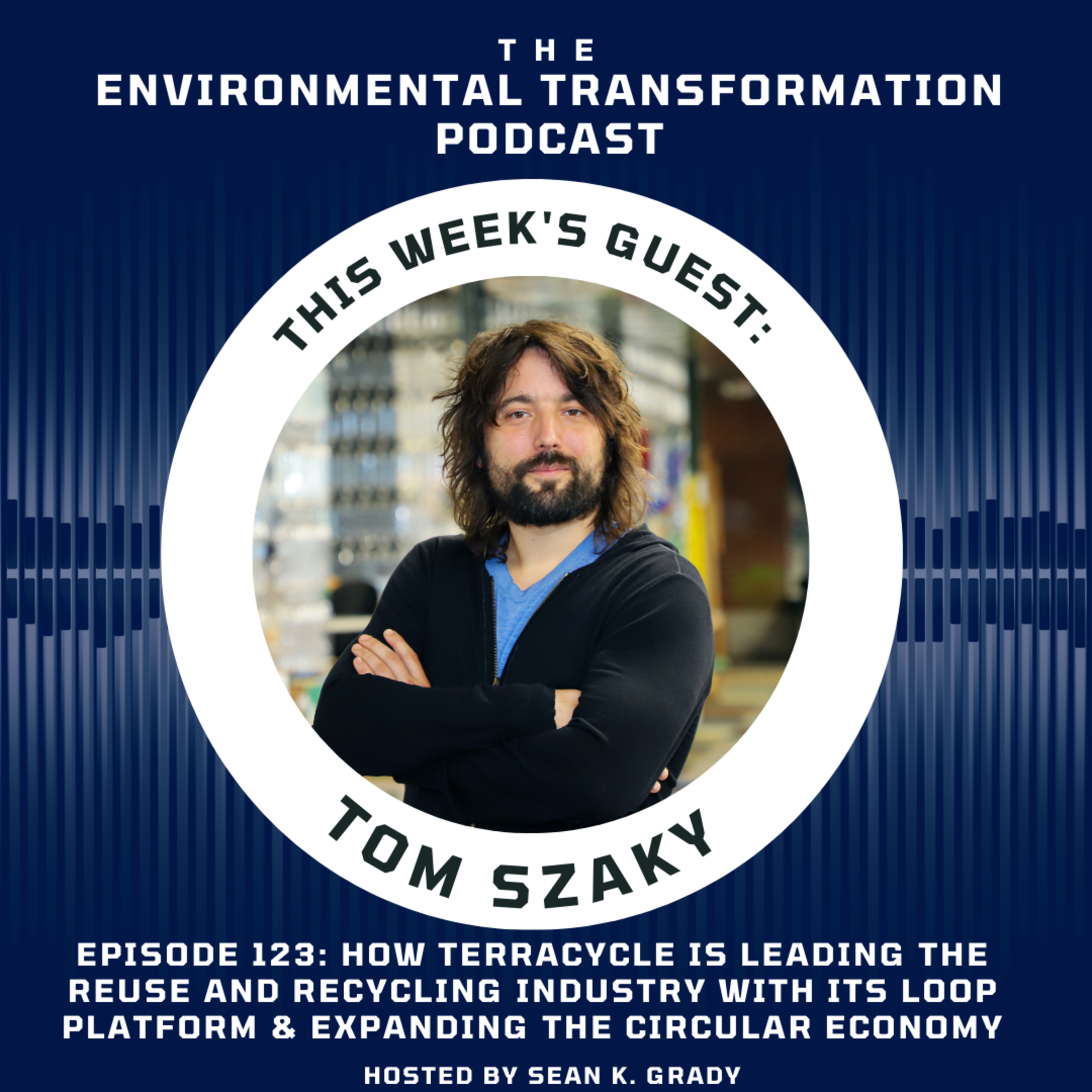
TerraCycle CEO and co-founder Tom Szaky returns to the Environmental Transformation Podcast with host Sean Grady for an update on what has changed since his last appearance in episode 20 in 2020. Szaky breaks down why most items are “not recyclable” because of economics, not technology, and why reuse is TerraCycle’s biggest investment through the Loop platform, including what it has taken to scale in France. The conversation also digs into U.S. recycling headwinds, extended producer responsibility, Senate Bill 54 and Senate Bill 343 in California, and why education and “making it fun” can move behavior fast. Szaky also explains TerraCycle’s current Regulation CF raise, the planned Regulation A offering, and where to learn more at www.terracycle.com.
Thanks to our Sponsors: Cascade Environmental, E-Tank, and WASTELINQ
0:00 Overall, as we think about the idea of waste, we stand strong that this idea should be an anomaly at some point in human history because it only really came onto the scene in the 1950s. Before that, all the outputs we produced were useful inputs to some other Organism. You know, everything, you know, our chairs would have been wood or our clothing would have been natural materials, you know, so on and so forth. It's really since the 50s that this sort of concept of waste has come onto the scene and it's a non natural concept. What we have been always thinking about is how do you use business models to try to create solutions to waste. Welcome to the Environmental Transformation Podcast, where we bring you interviews with industry leaders, climate champions, sustainability practitioners, EHS and hazmat professionals making an impact in their businesses today. Each leader solving complex challenges and delivering solutions within their areas of expertise. I'm your host Sean Grady and thanks for joining us today. Before we jump in, make sure to follow us on your devices and visit my website at www.seankgrady.com and sign up for our newsletter and e-mail announcements. Now let's get started.
1:05 Welcome to the environmental Transformation podcast. I'm your host Sean Grady. Today's guest is Tom Zaki. Tom is the Co founder and CEO of Terrace Cycle and international leader in innovative sustainability solutions provider creating an opportunity or creating and operating first of their kind platforms in recycling, recycling materials and reuse across 21 countries. Terracycles on a mission to rethink waste and develop practical solutions for today's complex waste challenges. The company engages in an expansive multi stakeholder community across a wide range of accessible programs from Fortune 500 companies to schools and individuals. For the listeners who've been on the show or been following the show for quite a while, Tom came on the show during episode #20 so that was the first year we started this back in 2020, which I kid and hardly believe that it was. It's been five years Tom, since we last spoke, which, you know, at that point I was just figuring out how to do this podcasting gig and you are one of my biggest guests at the time back then.
2:15 We are super excited to have you. And here we are over 100 episodes later and yeah, we, we're still going strong. We we're doing about 20 episodes a year and that's just enough to kind of keep a really good, you know, two a month type cadence and a little break here and there between holidays. And it's, it's been a lot of fun. And so, Tom, welcome back to the show. I really appreciate you, your time and coming on. Thanks for having me, it's a pleasure to be back. Yeah, I mean, you, there's been a lot happening since in the past five years. I mean, so I think it was one of the posts I saw that, you know, you you put out on LinkedIn. And I was like, you know, I would love to have Tom come back on the show and kind of update the audience because there was so much you guys been doing.
2:59 Yeah. This would be great. Yeah. You founded Terra Cycle with this mission to eliminate waste at a time when sustainability was just, you know, far from mainstream. But now it kind of has been the big focus of mainstream in the past five years, and in large part by a lot of things you're doing others. But how has your philosophy around eliminating the idea of waste, which is kind of one of your themes here, evolved as Terra Cycle has grown into a global enterprise? Yeah, absolutely. And and it's interesting you say that, you know, we've been doing this now it's year 24, the quarter century next year. And you know, when we started Terra Cycle, it was, it was very much sustainability was just emerging. You know, you didn't have chief sustainability officers at companies. There may have been someone who sort of thinks about it on the side to now where you see a lot of regulation coming. It's certainly a department.
3:47 It's, it's really evolved in a very big way for us overall, as we think about the idea of waste. This has been something that's been a lifelong fascination of mine. You know, we stand strong that this idea should be an anomaly at some point in human history because it only really came onto the scene in the 1950s. Before that, all the outputs we produced were useful inputs to some other Organism, you know, everything, you know, our chairs would have been wood or our clothing would have been natural materials, you know, so on and so forth. It's really since the 50s that this sort of concept of waste has come onto the scene and it's a non natural concept, you know. So for us, what we have been always thinking about is how do you use business models to try to create solutions to waste?
4:28 And that historically started with how do we recycle things that are hard to recycle. That's continued to flourish and grow, but we've also put a lot of investment into how do we go beyond recycling. For us, we believe that is the idea of reuse and that's been our singular biggest investment as a company is really seeing how we can mainstream reuse and do that at scale. We've done that through our loop platform and happy to say, you know, it's not worked everywhere, but in France. It's the biggest reuse platform in the country today. And if we hope that we can then build on top of that and bring it to more markets and even more scale. You know, I've been to France many times, my wife and I. My wife's more of a Francophile than I am, but we go to France quite a bit.
5:11 In the past five years, I think I've been six times. So we enjoy the the culture and the food and everything. But when you go to like certain restaurants there, AKA maybe a McDonald's, Kentucky Fried Chicken or whatever, they've got these reusable products. I think there are the loop products you guys are using and I go, you know, I know the guys behind that. That's really cool. Yeah. And look, this is where France leads. And I would say it's an important note for why, right when we started Loop. And I mean, we've invested $50 million into reuse. So it's been a big one for us. We ran pilots in US, Canada, UK, France and Japan. So we took a lot of bets, if you will, on the proverbial global roulette table.
5:52 And France was the one that was able to really get the scale. And the reason is that something as profound as we use needs regulatory support. And what France has is that regulatory framework, which is absent everywhere else. France has laws that are A, mandating reuse, but B, also subsidizing it so it becomes economically competitive when it is embryonic and scale and then that subsidy is not needed, needed as the scale gets bigger. And I think that's important because today and you know, many countries we are deregulating, right? And I think it's important to note in sustainability in some places regulations not needed, but in other places it is pretty central to ideas transforming. Well, I mean, that's great. And I really applaud the the reuse practices that Loop's been doing, especially in France and other other locations. I hope it would pick up more here in the US, but there's needs to be some cultural changes, obviously, and some economic changes and from a business perspective. But I was reading a a recent article that came out by the National Waste Recycling Association's president, Michael Hoffman.
6:58 He says he's raised concerns about America's circular economy is at risk. And he says we want, he says, he went on to say that the unified recycling PET imports, reduced brand commitments and declining demand for domestic recycling content is threatening US recycling infrastructure and the jobs in the communities that support it. Is Terrace Cycle also seeing this kind of play out in real time right now? And you know, if So, what can be done to change this concern? God, it's a good, it's a good point. And I would say the punchline, and I'll dive into it, is that yes, we see this in general recycling. Terrace Cycle seems to be immune to this and I'll explain why in a moment. But it is important to note that in general recycling, that's absolutely the case. So maybe just to dive in, the general recycling business model is a very simple equation.
7:47 As a recycler, you would think about what is your cost to get certain inputs. Let's say you're interested in PET recycling. So what's your cost to get it and turn it into a sellable output? Those are your cost basis and you compare that to what you can sell the output for. And so you are highly exposed and very dependent on raw material value. And if raw material gets cheaper because maybe virgin prices and oil prices are going down, then you might not have a business model to run. And that certainly expresses itself in traditional recycling. Now what makes something traditionally not recyclable? It's not that it can't be, is that it just costs more to collect and process and the results are worth. And mind you, this is the case for the majority of objects. Our toys, our cosmetic packaging, our wet suits to our bicycle helmets, our writing instruments to our toothbrushes are not, are not recyclable, not because they can't be, but because they just cost more to collect them process and the results are worth.
8:39 And this by the way, is getting worse every year, not better. Because the biggest mega trend in object design, I think across all objects is make it cheaper tomorrow than today. And there's virtues of that. Of course, it becomes more affordable, more profitable, one or the other or both. But nevertheless, that is the trend. You know, the best thing I would say is take any object that's been around for 100 years and look at its versions over decades, and you'll notice exactly that trend showing up. Yeah, on everything, clothing to biscuit packaging to toys. Right. And so that makes things then progressively less recycled in the traditional context. The reason we've been immune to it is we don't depend a Terra cycle on raw material value. It is a subsidy, but it is not a dependency. So for example, when we collect and recycle coffee capsules, sure, when we sell the aluminum that comes out of that, there is some value, but it offsets maybe 1% of the cost. So if aluminum double s in value, OK, it offsets 2% of the cost.
9:33 But if it goes to 0, which are, you know, hyperbolic examples, it would increase cost by 1%. It's not that big of a driver and that allows us to not be challenged by that type of trend. Now, relative to overall recycling, Terra cycles tiny, right? We're about 100 million in revenue. The overall recycling industry is orders of magnitude bigger than that. And you're right, this is an important thing to be very aware of, right? Traditional recycling competes against virgin materials, and virgin materials are cheap to extract. Yeah, Yeah. Well and then the comment about, you know, these unverified recycling PET imports and having lower cost version product coming into the country to be used, you know, for that that virgin product.
10:16 I'm my mind's thinking, OK, one, there should be a regulatory framework that's, you know, kind of maybe puts a little more emphasis on using recyclable content that's maybe generated in the US versus taking it from some other country. And maybe maybe to stem some of this influx, maybe a little couple extra, some tariffs on some of this stuff could help, you know, so that puts more pressure for, you know, the local industries to produce it. And then maybe this there's a little more commitment from some of these companies to use recycled content and get some sort of incentive for it. I don't know but where we need to go with this, but I I'm. I think all of the above, I think America based on its regulatory sort of leanings, the easiest would be doing things like subsidies, you know, let's subsidized recycled content produced domestically. I think your point is incredibly valid and using post consumer, not only post industrial content that should have a subsidy against it so that it's easier for recyclers to compete because I think to the lay public, what's in what I think many people don't note is recycling is a tough business. Yeah, it's dirty.
11:23 Business, it's not easy. It's dirty, smelly, gross, but it's also not oozing in profitability. Yeah, You know, and I think that it is important to help offset that. And we have mechanisms for that. You know, we subsidized certain industries to make it easier, you know, to create domestic value. And you know, one of the really interesting things I saw is where suddenly like, you know, take a tangential example, like the clothing we use space, which is somewhat tangential to this, you know, think companies that are big in that thread up and reel to reel or rent the runaway. You know, these companies that are doing re commerce and clothing, their business models have really struggled. You know, they've really struggled to make money. And if you look at their share prices, they've been on a progressive, you know, decrease. But when tariffs came in and made it more expensive to bring in foreign goods, that's that was what created the first rally in their business models.
12:15 And they started really moving in the right direction. It's not to say I'm advocating for tariffs or not, but just more to say that some form of economic benefit to these domestic players is important because, yeah, on their own, the businesses are not as easy. Yeah. And I don't know if Congress or you know, some of these Congress people will take this type of an approach and look at it a little closer, but who knows, maybe somebody will take the mantle and then run with it a little bit and and maybe it'll be some legislation implemented. But you know, there is legislation expanding. And then I want to get into this. I mean, you know, with governments in introducing stricter EPR, which, you know, the extended producer responsibility mandates and ESG reporting requirements, or should I say expectations, How do you see terror cycles roll, you know, shifting?
13:01 Because I gotta imagine EPR is a big benefit to your business. Yeah, when you're in the right location where those expectations are real. Yeah, absolutely. So in EPR, right, if we look at the 20 countries where terror cycle operates, the vast majority have had federal EPR for a very long time. And in fact in the Germany, Austria, Swiss regions, the second biggest PRO which the administrator of the PEPR taxes owns 25% of our business. You know, so we have really great connections there. And in fact, in America, this is what we're seeing now state by state is where the regs are coming. California, especially with Senate Bill 54, Senate Bill 343, Senate Bill 54 more the EPR bill, Senate 343 is more the truth in recycling labeling bill, but it's coming now.
13:46 It's challenging that it's going to be hyper fragmented, you know, across every 50 state. One unifying factor is that CAA seems to be the operator of most of these EPR, you know, regulations, at least the same body that's going to be affect, you know, becoming the PRO for us. The way we interact with the EPR is 1. When we collect and you know, we focus on the things that are not locally recyclable, right? We don't want to recycle, you know, collect through Terra cycle things that are locally recyclable, but things that are not is our domain. And so in many cases we work with the EPR organizations to become those alternative collection models for the things that the core blue box curbside recycling is not for as big as like in the state of Maine. We run the state's entire e-waste EPR system goes through US, you know, so it can be anything from electronics all the way to food packages.
14:35 We also see that in in for example, California regulation, the Senate Bill 54. There is a lot of talk around reuse. So that could, you know, bring out the type of work we do in France with reuse into the US at a level of like a state of California. And generally we think it's, you know, it's a good thing to start producing the obligation to pay for those externalities. I think the thing that needs to be eyes wide open on an EPR is EPR is not necessarily a silver bullet. It's a funding mechanism and it generally moves the funding for recycling away from municipalities, which is expressed to us individuals in our property taxes or if we don't own them in our rent to our product prices because it goes to the producers. So it's sort of moves from a property tax to a sales tax. The important thing to really be aware of is the net funding increasing or is the net funding static or is it decreasing? Because we've seen, for example, in some provinces in Canada, the net funding goes down when that move occurs and in fact, less things get recycled.
15:34 So it's all about the money flow, right? If the money flow increases, more will get recycled. If it actually decreases, which is could, less will get recycled. And I think that to me has been the biggest unlock in thinking about this whole topic of circular economy is that it's not about technical anything. It's about the money flow. I'll, you know, I'll give you a joke that's been really an easy way for me to express it. I'll play that with you if that's all right, which is imagine a cup is going to appear in front of you and it's gross, it's dirty, right? You can't just drink from it. You're going to have to go clean it. And my hope is that in a vacuum, like no one's watching, you know, there's no law telling you to do anything. You're going to take that cup and clean it and drink from it.
16:17 So the first cup I put in front of you is a cup made from solid gold. What's your action? Are you happily gonna take it or not? Yeah, absolutely. Yeah, and I imagine you would. And you'd still clean it because it's valuable, right? Yeah, and you'd take more and more if more were to appear fair. Yeah. OK what if it's now a cheap plastic cup? Horrendously dirty. One of those like 5 cent plastic cups. Yeah, maybe. Depends. Probably not, right? Probably not, right? Depends on if I still have a bunch of those gold ones sitting on the shelf. Yeah, yeah. So imagine it's just that. I imagine you'd ignore it right now. What could get you to behave the same way on that plastic cup as the Gold Cup? I imagine if there was also some money in the cup that is yours to take if you take it and clean it, right, and it's some money level, let's maybe call it a $20 bill, you go, great, I'll take and I'll take more.
17:09 And I think that's the essence of this to create cuz recycling is a free market system. There is no law forcing any actor to behave right. So it's all free market. Which means either the reason to collect and recycle has to be embedded into the object, which means the value of it needs to be good enough to bother dealing with it. Like an aluminum can or a corrugate box. Or it has to be given to the object. If it isn't, and if we acknowledge that the biggest mega trend is to move from the Gold Cup to the plastic cup, everything is moving in that direction, then it's about watching the money flow that's attached on top of it. Yeah, yeah. That's good. That's good. Hello, ET Nation. I want to thank you for listening to the podcast. If you're enjoying the interviews we bring you, consider supporting the program by visiting my website at seankgrady.com and buy me a cup of coffee.
17:56 Proceeds will go towards helping me continue producing timely content and offset production costs. I'd also like to take a moment and recognize a few of our sponsors of the show who have been amazing partners and our ET Nation legends. If you're looking for a drilling and environmental contracting firm to help you delineate the extent of contamination at your site, then look no further than Cascade Environmental. Cascade has over 37 offices across the country and offers a huge range of environmental and geotechnical drilling, site characterization, and remediation services. With their huge fleet of equipment nationwide coverage, Cascade is a great choice to support your environmental and infrastructure needs.
18:38 To learn more, check out their website at cascade-env.com. That's cascade-env.com. Hey, are you looking for an equipment rental company to help you with your next wastewater remediation or waste management project? E Tank is the only environmental equipment rental company in the industry that offers 100% guaranteed certified clean temporary liquid storage tanks at no additional cost. This protocol gives Peace of Mind for the previous customer by limiting their downstream liability as well as the future customer by preventing any cross contamination for all of their rental tanks. E Tank also runs a one-of-a-kind complete maintenance program for all rental items including liquid tight roll off containers, fluid transfer pumps and filtration items. The next time you are presented with an environmental challenge, call E Tank to come up with the solution for your problem. I want to thank one of our sponsors, Waste Link. Waste Link is the all in one software platform transforming how environmental professionals manage waste, connecting generators and service providers and disposal facilities in a way that is simple, connected, and transparent. Their platform helps streamline everything from waste profiling and routing to inventory management and billing, giving you the tools you need to operate more efficiently and reduce cost.
20:06 Whether you're a generator looking for better options or a service provider seeking greater efficiency, Wastelink has you covered. If you're ready to take control of your waste management processes and optimize your business, visit wastelink.com to schedule a demo today. You know, I think, I think a lot of people also through education, and I think that's for another area that we don't really focus enough on is this concept of educating the public on the value and the virtue, so to speak, of just proper recycling and having constant, you know, like Schoolhouse Rock. I, you know, videos for kids that that they, they can just have it in their background going on.
20:49 They're learning about it and it just constantly is playing and looping through their normal daily life. And they're always getting a little seed planted about the value of doing this. And I don't think that we're doing enough in that space from, you know, an education perspective to see the value. Of it, yeah, I think you're right. And you know, what's nice about that theme from an education and communication point of view is reduce, reuse, recycle is the first lesson we learn in school. That is not a climate change lesson. It's not a diversity of species lesson. It is a circular economy lesson. It's very easy. It's the only thing really in sustainability that we physically touch, you know, that it's and we physically make a decision on what to do, you know, with the with the waste.
21:30 And I think if we drove excitement, a huge benefit will come. You know, we did this study a number of years ago with one of the big beverage companies where we put out recycling bins and trash bins and busy train stations, and they were both clearly marked right beside each other, so there's no difference. And we watched how many people would put the recyclable bottle, like an aluminum can or PT bottle in the recycling bin. And honestly, it was only half. The other half, we just throw it in the trash bin, and they're right fucking beside each other. Like, yeah. You're like. Yeah, then we added excitement. We added some devices that when you put in the recycling bin, it would thank you, like the bin would speak to you or it would create some cool sound effect. Just some excitement, no money, nothing else. It went to 95% good.
22:11 And we even saw people pulling out of the trash can to put in the recycling bin or litter off the ground and putting in the recycling bin to get that fun. And that little excitement I think goes a long way. And it's important because if you look at the narrative around recycling, I would say 20 years ago it was there like that. Now there's a lot of vilifying at oh, recycling doesn't work. Oh, why bother? There's a lot of media around being negative on it and recycling isn't perfect, but it needs to be supported as much as possible, you know, from communication as well. I mean, I could just imagine, I mean you could really gamify that whole thing with, you know, AI and and video cameras. Now you can have those two bents in there and submit those in a recyclable product in the trash and go.
22:54 Yeah, yeah. And I think it's not and. Then like it goes with the right one, they go, yeah, you know, I think pause. And it's, you know, look, it's not that people are bad. It's not that they are the aluminum can consciously, Yeah, it's not that. It's that we are so busy, it's more apathy and you can correct that by just a little bit of free stimulus. It's not. Yeah, right. People for it, yeah, I think that would be kind of a neat little project and you see recycling rate scope, Oh, man. Certain locations, yeah, right. Totally true. Totally. True. Yeah. Well, you know, OK, well, let's stay on the loop concept here because the platform is really good. And when we first spoke five years ago, you were just kind of getting underway with launching it and then having some initial success, which I believe, you know, that was one of the reasons I think we definitely connected back then was this whole loop concept and I thought this is really great. So here, you know, Loops representing a bold vision for reusable packaging and circular retail systems. So, you know, let's maybe you could talk a little bit about some of the companies you're working with and also, you know, what have been the biggest logistical or behavioral barriers to scaling Loop globally and how are you addressing them to make them more convenient for reuse, eliminate single use, you know?
24:10 Yeah, no. And it's been a lot of unintuitive learning, so I look forward to diving in. So first, just what is Loop's role? Right. So think you know, products like a ketchup bottle or a shampoo bottle or you know, a bottle of Coke, you know, or you know, whatever it may be, a bottle of laundry insurgent. So our role is to try to make all that reusable and we have two ways, 2 functions that Loop does. One is we become a system steward. So we are out there talking to all the major producers to join in and then all the major retailers to sell this stuff those because we don't want to be a producer or a retailer. And that's been, you know, one big success point on Loop is we were able to get 200 of the world's biggest consumer product companies to join. Think you're Unilevers, your P and GS, your Pepsi's Cokes and so on and so forth. All the way to Nestle and P&G are investors and part owners of Loop and so on.
24:56 And the role when the brand comes in is we help them enable reusable versions of their product. How do you make sure that that product, that package is reusable, that it can go around and our threshold is a minimum of 10 times. Then we go across and then work with the retailers to make sure that they dedicate shelf space to these reusable offerings and enable that a consumer can bring back the used packaging to the store and put it into a loop bin. That's to call it platform stewardship. Then our operational function is where the waste management function of reuse, where we are the bins, we service the bins, we return deposits, we sort out packaging almost like a Murph, but down to a product level at a food grade standard. So exactly like a Murph, but the opposite of like a quick conveyor belt in a dirty environment. Think like food grade down to a product level and then instead of shredding and melting, it's cleaning and then it goes back to the producer.
25:47 They fill it up and sell it to the next different consumer. The American proxy would be propane tanks, but imagine that expanded to all consumable goods from gummy vitamins to infant ointment. I mean, you name it, anything that goes in the package. So that's the essence. Then we effectively took pilots with all the world's biggest brands and retailers, like here in the US, Walmart all the way to Kroger in Canada, Loblaw, which is their biggest retailer, UK, Tesco and so on and so forth. Carrefour in France and we first land on online pilots then we transitioned that's probably when we spoke five years ago then we transitioned that to in store pilots first interesting point because we mentioned behavior you couldn't tell the difference between American, the Japanese, the Canadian, French or British consumer. Everyone behaved the same.
26:34 They were totally fine with it, liked it, did the returns all. And in fact, all five countries don't have active package reuse systems on them today. It's not like the French public are returning, you know, like in Germany, for example, where you do return your beer bottles and certain soda bottles for deposit and refill. Yeah. So that all went well. Then we're able to get into pilots, 10 store pilots, give or take, you know, in all these markets. And that all went well. And that's where we really saw a big differential between France and everywhere else. France continued to scale aggressively. And in all other markets, we were not able to get out of pilots. So we shut those down. And France became this whole sort of, you know, bastion of success, while everywhere else we shuttered. And the big reason is the regulatory environment in France.
27:18 There's mandates mandating that reduce must, you know, be adopted at a certain scale by 2027. And their subsidies helped offset some of the early adoption costs. So that allowed us to really scale. Now, what are the some of the unintuitive learnings? And these were, I'll give you 2 of the biggest ones that like I, you know, wow, I had no idea this was the case till we learned it. The first is consumer behavior. Because when you talk to a brand, when you think consumer, if it's an oral care brand, you are only thinking about the consumer behavior around toothpaste. Or if you talk to a Coca-Cola, it's only around the consumer behavior around a can of Coke. Right. Yeah, yeah. And you get really sort of pigeon holed. But the reality is when you and I go shopping, we're not thinking about toothpaste or or coke.
28:01 We're thinking about shopping and getting in and out of that shop quickly and efficiently and, you know, getting what our family want. Yeah. So here's a good example of something unintuitive when we did, let's say, a reuse display with five products only, and this would be in France. An example was like a Heineken, maybe a still and sparkling water with Damon and then like two different Coke flavors with Coke, like 5 products. The sales were pretty low and the return rates were dismal, like 10% of the packaging would come back. Then you do the exact same store, same everything, but go to 50 products. So all those same water, coke, beer, but then you add on shampoo, conditioner, chickpeas, you name it, a whole random assortment of 50 products.
28:42 The purchase rates go up close to 2000% more per product increase in sales and the return rates go from failure like 1015% to 8090%, which is a great success. And So what that taught us is consumers won't do reuse in like a product by product vacuum. They will either do it big if there's a lot of choice or not do it at all. And that includes the purchase and especially the return, which is a key KPI in the world of reuse. I could see that I because, you know, basically it takes too much effort to sort out the one or two or five pieces versus the 50 pieces they currently do every day. They're like, I just want to do it all at once or not at all because it's. Too much.
29:24 You know, the best metaphor is I'm not going to make an organic salad with just organic tomatoes. Yeah, So that and there's lots of derivatives of that learning that came up. But that was a big one for us, which means that reuse has got to go big systemic or has no chance of success. Another was when we first started Loop, we got really seduced and so did all of our partners by the idea that when you move to reuse, the package suddenly becomes a depreciatable asset and not a cost of goods sold. In other words, in a disposable package, you got to embed the entire price of that package into the singular purchase at 100% because the consumer owns the package in the end and you never get it back. In reuse, you embed only the use of that package.
30:08 So if that package is going to go around 30 times, every consumer is only charged 130th of the cost because it becomes a depreciatable asset. And what that opens up is the ability for the package to become incredibly beautiful, like Haagen Dazs containers made from stainless steel with insulation properties and like the best type package you've ever seen or Cascade package ever museum quality type stuff. And that is true, but we forgot the pragmatic, which is that a consumer product company like Nestle is wonderful at making anything in small volume out of a lab and then great at making it a massive volume, but really can't do anything in between those two book ads. And so suddenly in some of these pilots where we were fulfilling these beautiful, gorgeous packages at 5 stores, 10 stores, producers came to us and said, that's all great, but don't call us until you're at 1000 stores because we can't fulfill anything in between that.
31:03 And remember the first lesson, which is you need a massive assortment. Suddenly you have this no man's land of how do you, because the retailers can't scale that fast because they're scaling a system, you know, so you got to scale it like 20 stores here, 50 stores there. And so that took us on this whole journey of how do we solve that? And what we realized is if you take all packaging forms in the world, all of them something that packages the content and you put them on one end of the spectrum, the most expensive packs per kilo or liter of what you're packaging. Think perfume bottles, laundry detergent bottles, the wine bottle, Scotch bottles, things of that nature. And on the other end, you put the cheapest way to package a kilo or liter thing, flexible film, you know, yeah, even like even cheaper like a pouch, you know, or a or a bag for potatoes, right.
31:47 Put it over there. Yeah that bottom third those packages, most of them already conducive to reuse like a Scotch bottle. You don't have to improve its quality to be able to have it to go around. It's honestly way over designed to be used. Once way over designed it can easily be cleaned and refilled and boom, no package change. And in fact 1/3 of packaging on a supermarket is already conducive to reuse with next to NO0 to next to no changes at all. And those you can scale through that no man's land. Yeah, wow. And so there's a lot of these sort of very interesting unintuitive things, but I think the key punch lines are it's not the consumer at all.
32:30 It's entirely about getting the businesses to go through the journey because the consumers, they're willing and good to go. Yeah, yeah. I kind of feel like most people would or will recycle. Yeah. Providing it's, you know, I think either easy, right? You know, it's easy. I mean, let's just be honest, everybody wants to make it easy. So if it's easy, then you know, then that's going to be something they'll do. I think more people would do it if there is more education. So they're more aware in certain communities. I think there are probably less interest. And I think some certain age groups of people are like left.
33:11 I would have to say some of the older people in like baby boomers are probably like, ah, you know, whatever. But then, you know, GN Xers and Millennials, the GN ZS are really. Like God, it's the younger are indexing high because that they're the future of where the planets moving and it tends to be greater greater for kids that have grown up where climate change has been the thing their whole lives versus like you and I, you know, it wasn't a thing when we were born. Yeah, exactly. So they're, they're and they're putting their money where their mouth is on their value purchasing too, right. You know, they're, they're really doing that, which is good, which is cool. I mean. Look, I that that gives good optimism, you know, and I don't think it's rocket science to solve this stuff. It isn't. Yeah, yeah.
33:52 You know, so I've been on Facebook a lot lately and I for some reason have got the right algorithm going on because. You're the right. And I see his terror cycles with this big IPO reggae going on. Let's dive into that talk about that. I think that's pretty exciting. And let's see, you know, maybe, maybe you'll entice a few listeners to invest. Yeah. Well, thank you. You know, absolutely. So first and foremost, you can learn all about everything that I'm going to describe in a moment at invest.terracycle.com. And we do file with the SEC now for gosh, five years our U.S. company. So all that financial information is posted on sec.gov.
34:36 And I would really recommend if anything's interesting what I'm about to say, please, please download those filings. And you know, do you know your own review, but that we are in the middle of a major capital raise through what's called a Regulation CF and then later will be a Regulation A financing where basically folks can invest a minimum of $1000 and invest and own a part of Terrace Cycle US. And we did this the first time five years ago, actually very close to the time you and I chatted last, where we raised $19,000,000 into Terrace Cycle US. And what's nice is if you invested in that, in that time, you would have already gotten back I think somewhere between 17 and 20% of your invested capital and dividends. And that capital allowed us to really grow the company which grew during that period, I think 75% in, in scale like quite, you know, quite a bit. We did that through doing 3 really exciting acquisitions in the US, you know, looking at companies that do e-waste recycling or battery recycling, light bulb, these are these specialty recycling groups.
35:34 And this is something that we're excited to do again. You know, we've been profitable for over a decade or we've seen really good growth. And at some point in time, we would love to get to a liquidity event like an IPO. And this is the like the right thing for us to do now to like, you know, really gear us up for some fast growth before something like that might, might occur. So we're really pumped about it. The, you know, investors the first time around, I think have done very well. A lot of those guys have reinvested in this round. And again, at invest.terracycle.com, there's all sorts of information, but I especially encourage folks to go to the SEC filings because there you get incredible transparency into the company's financials and its goals and so on. Yeah, no, that's great, Tom. And I like I said, I really like the ads that are out there and kind of how you're, you know, talk about changing the the mentality of recycling and, you know, recycling those difficult waste streams or those weird things that people don't think about, you know, and and I think you guys are tackling some challenging ones, which is really good. I mean, and, and I mean there are other companies doing similar or something at scale with a large, you know, investment in recycling plastics and things like that. But I think you guys are doing some really cool stuff there and so excited to see you guys get some investment revenue coming in.
36:53 So how much longer is the IPO or the the reggae, you know, offering going to be open? For you guys for. Investors. Right now we are in what's called The Reg CF which comes before the reggae. That's for $5,000,000. We are as of today around I think just over 3,000,000 has come in. We expect that to close, you know, probably by end of this month. It's, it's really accelerating quite nicely. Then we go through the process with the SEC to approve the reggae and that would probably assuming approval though we got it last time. So I'm, you know, not too concerned, but assuming that goes live early next year and there we would raise potentially up to 75,000,000 during 2026. And this allows us because we don't have losses, it's not about plugging losses, it's about really increasing investment into organic growth and doing some really good strategic MNA as well.
37:41 And so we're really pumped to be able to lean in on doing that. And you know, we should based on the CF be able to announce an acquisition early next year that we're working on. And then if we do the reggae, then do some even more bigger ones ideally. That'd be great. Well, you know, one of the little benefits for investors or potential investors who are considering right now is talk about this real quick is there's you could earn a 10% bonus. That's right. You know, let's get the enticements a little stronger here. The yeah, yeah, absolutely. So in when you go to invest.terracycle.com, you'll see there this idea of bonus shares. This is unique to this first 5 million only. This is not going to be available in in the reggae and they're effectively depending on when you invest, you can get, I think if I'm not mistaken, up to 25% extra share. So basically what that means is if you invest a dollar, it behaves as if you invested $1.25 got. You.
38:36 Yeah. So you just get more equity. And what's nice is, you know, every year, historically, we've paid out dividends. You know, so you get a dividend check from us and then the equity value grows as we get bigger. Well, that's great. I mean, I think you guys are going to do well with that. And for the audience listeners, I, you know, recommend you guys check it out and if it makes financial sense for you guys, jump in and I'm sure Tom and Terra Cycle would love to have you guys invest. We would, absolutely. You know, let's let's dive in if we could a little bit about some of your partnerships. I mean, you guys are a process, you process a lot of stuff, but you don't manufacture really anything that I know of and you don't really have a tremendous amount of assets in person. I mean, you got some, but I mean, talk about your partnership network.
39:20 I mean, terror cycle success relies heavily on these partnerships with some of the world's largest consumer good companies, which is huge. And then also, you know, how do you navigate the tension between partnering with the major plastic producer and, you know, also advocating for waste reduction in circular design? You know, it's like, yeah, yeah, yeah, yeah, absolutely. So first and foremost, how does our model work, right? Like we are only dealing with things that are not locally recyclable, which are not locally recyclable, like a Gillette razor blade to a RIP curl wetsuit because it costs more to collect and recycle than the results are worth. So we need funding from a stakeholder to be able to offset those economics. And that could come from a producer.
40:01 And we're very proud that we work with most major producers out there. You know, from your Nike shoes all the way to your Ferrero chocolates, right? And hundreds and hundreds in between. Over 40,000 clients. It could be retailers like your Walmart all the way to boutiques, you know, like Akhil's Boutique and so on and so forth. And we get funding to then be able to effectively make recycling for these objects work. That's the sort of business model, if you will. And the funding can come from, you know, these big producers, They could also come from direct consumer purchases. People can go to our website. We always recommend if you do go to terracycle.com, check out the free programs first that are paid for by these partners. And then if you still want to recycle something where there's not a free program, use one of our paid services where you effectively are picking up that that bill. That would be like our zero waste box division and so on. That solves the economics.
40:49 Then our operations, you know, we have collection, sorting and processing and we own and operate about 25% of our supply chain and then we use different third parties for the other 75%. So for example, in logistics we own and operate a lot of our regulated waste logistics. You need a lot of permits and you know, and capability for that, while waste that doesn't require permits to move around, we use third parties. And in that process, what we do is we basically take the waste and we give a legal guarantee that we recycle everything, which is quite unique. And then from there, we find manufacturers who need these inputs to make their products. So it could be like chip bags turn into automotive parts or let's say baby food pouches turn into drainage pipes and things of that of that nature. What's really exciting to us though, and this goes back to the partners, is when the partners want to take that waste back into their ecosystem.
41:37 And this would look like with Pilot pens, we've commercialized the world's first pen from used pens in our Japanese division or with ASIC shoes, they're for shoe made from used shoes and a ton of other examples. Like, we love it when the partners don't just want to see that object get recycled, like Asic's wanting to see shoes get recycled, but then say, how do I help make shoes from that recycled output to us, that's phenomenally exciting and starts doing what you were talking about earlier is keep these materials domestic, keep them in the supply chains. And then it also reduces the need to do new extraction, which is the number one cause of all environmental harm is extraction, farming, mining, those sort of things. Yeah, yeah, I know, absolutely.
42:18 I mean that's, that's really good. Lots to go there. I mean, you know the your downstream partners too, I mean that you're partnering with I'm sure are are really important for you guys and you know, you probably have a handful of a handful hundreds of them probably across the country. You know that there that's a that's like the lifeline for a lot of your business, right? Yeah, Yeah, it's very important. The distinction though is we don't depend on certain raw material prices being hit. This is one of the really magic sauces in our business is almost all other recyclers need a material to be at a certain price to make the engine work because the key revenue is selling that material. So if you're a polypropylene recycler or APET recycler, you need polypropylene and PET to hit a price for your business to be profitable.
43:03 When it goes up, it's even more profitable. And inversely, it's sort of like a drilling for oil. If you know the price per barrel goes down below a threshold, certain drilling activity doesn't make sense anymore. Yeah. Right. We are really different because the economics for us are not the key. The the economics of the output materials are not a key driver, right? They are a subsidy, but they are not really going to materially affect the price because for us these waste streams were never profitable to recycle. It never made economic sense to recycle a pen. And the value of the resulting pen plastic maybe affects the economics 10% one way or another. But it's not the material driver that allows us to to say we can sell the materials at whatever the market can absorb them at. So we don't have this issue of we got to wait till raw materials hit a certain value.
43:51 That's really good. You know, technology has really advanced a lot in the past five years since we've spoken and not that it there wasn't already present then, but it seems like, you know, it's, you know, exponentially advanced. And since then, how's Terra Cycle investing in technology, especially around AI, data analytics, tracking systems, things like that to improve the material traceability you're, you know, optimizing recycling streams, providing more accurate ESG reporting for your partners. What are you guys doing in that space? How much you investing in that space? You know what's talk about that? Yeah, absolutely. Quite a bit. Not an AI to be fair, right. I mean we use AI as a tool, right, But it's not like, you know, a key operational investment area, but a lot of other areas.
44:36 We just opened a multi $1,000,000 laboratory here in our Trent, New Jersey headquarters looking at mechanical and chemical recycling innovation as well as we use cleaning innovation. That's been a big one from the R&D center that's been a long time coming. We also put a lot of effort into track and trace where it's big investments in the third party auditing all the way to systems that we can trace the material all the way through our supply chain. This allows our brand partners to make legal claims around, you know recycling occurring and allows us to be able to make a guarantee that all waste we collect will be recycled. That's a really, really, really big one. Then where we invest quite a bit, like total investment of dollars is into new equipment for our processing partners. So we may not run a processing facility, but we'll come into a processing site and be like, hey, here's $1,000,000, you know, a line that you can then implement, attach it to your production and now you can recycle cigarette butts or now you can recycle cosmetic waste or whatever the waste stream may be.
45:35 That's been probably fiscally by far the biggest area of investment for us is boosting the capability of processors by doing equipment investments into them. OK. I mean, that's great. That's good. I mean. The other thing too to note there is we believe that there's no silver bullet solution. So we, you know, many people have asked us like, hey, is it mechanical solutions or chemical solutions? We use both wherever they are the most prudent. And what we find is that what tends to come out, especially in complex waste streams is a lot of mechanical components and then maybe a chemical process here like a solvent process or a depolymerization process. They're mixed in with a lot of mechanical processes. So how, how are you helping these companies with their reporting of, you know, sustainability because that seems to be one of the things I think is maybe a, a differentiator and or you know, you know, it's added value to the whole business. This is a very important part, right. So in reporting what we can do is basically track in our recycling programs exactly how much of that waste stream was generated every location, you know, down to the day all the way through the supply chain.
46:41 This allows folks the big part of reporting now in the US is compliance with EPR. And so we work the biggest PRO there is CAA. And so we work to be able to register the volumes of what these different companies collect and recycle that is subject to EPR so that they can really say, hey, we are, you know, voluntarily recycling this percent of our waste stream in this state. Here's how it's flowing through the whole system all the way to end market. Are there any big elephants still out there for EPR that companies haven't really jumped in on to establish? You know. Establish a recycling circular business to to manage that. I would say from a EPR in specific, EPR still embryonic, right, like where have we seen EPR come out in the US is regulated waste streams, you know, think paint, aerosols, batteries, you know, universal waste per SE there.
47:30 It's been there for a long time because those are hazardous materials and a good industry is really popped up as you know to serve that. Where it's coming now is packaging and we're going to see that state by state. But what's left is all the product that's in that packaging, which all becomes waste 99% within the year of purchase. Yeah, yeah, right. And that you see in more EPR advanced countries like France coming already. But that's that's going to come, I think in the US over the next coming decades. OK, all right. Well, I mean, I've been watching another one company they they recycle tires. Yeah, called pre tread. I don't know if you've heard of them, but they're amazing firm. What they do is they do every they recycle every bit of the tire and then they make Rd.
48:14 barriers out of it. That's really nice. That's. You know, instead of the concrete ones you see out there or the. Big, You know, with electric cars, tire waste goes up. Yeah, yeah, yeah, they're much heavier. So you're, you know, using up that rubber at a much faster pace. Yeah. So they, they've been, they've been solving that unique challenge and and doing a great job. And that company's called Pre Tread and yeah, I encourage you to check them out. They're pretty good. They're, I like them good business model, you know, the consumer role and behavior changes. Many sustainability solutions depend on this, like active consumer participation. But based on your experience, what strategies have you have proven most effective at motivating consumers engage in recycling and reuse?
48:58 I mean, a lot like, I think we've been talking a little bit about it. It's the money like, like. Yep, Yep. If I'm going to pay, you know, go back to the old days when you put a deposit down for, you know, a six pack of Coke or 8 pack of Coke bottles, right? You know, is that really the big share it here or something else that we can do? I'll answer it for reuse because that's the, you know, the the area where people think there's the most behavior change. So the golden rule for us in Loop is we need reuse behavior to behave like disposability. We want it to feel like disposability. In other words, have the person do the least amount of shift possible. I think that's the most important behavior. Shift is don't actually try to go for shift if you can avoid it.
49:39 So everything we do and we use it to make it mimic A throwaway sort of process. A good example is when you return the loop bottles, we give you the option of a reusable garbage bag. So you put in all the bottles like a garbage bag and you just drop off the garbage bag and people love that because it echoes the concept of waste. So that's really important is to in behavior change, first go for the least amount of behavior change. Then what are the other vectors? It's three, you know, that really drive behavior change. It's economic incentive. You know, that would be like getting a deposit back in reuse. It is fun. How do you smile? How do you, you know, like like some of the examples we talked about earlier, like create happiness and happiness can come from fun. It can come from feeling purposeful, doing the right thing, you know all that.
50:23 And that's a really important motivator. And then the third is you got to communicate it. People have to be aware and we use our biggest test for good communication on packaging is the spouse test. The spouse test is person A bought the thing and it's totally aware of how it functions, but the last drop was consumed by person B and they need to know what to do. And that comes through in really good communication. And it's those three things that really help create, you know, the solutions. Don't ask for behavior change and then motivate it with those 3 vectors. Yeah, Yeah. That's good. That's good. Yeah, I would agree. And and that more education would be really be like we've touched on it earlier, but the education seems to be the one kind of I think I think we could easily do right.
51:04 Well, you know, Hey, Tom, thanks for coming on to the show. I I've got one last questions. You look ahead at 20-30. You know, what does the future for Terror Cycle look like for you and Loop? We're really excited. You know, we are seeing continuous growth by then you know, we we hope to have hit our liquidity event and you know we're getting there by investing in recycling, hard to recycle materials, recycled content, especially reuse we think is a huge game changer. And by 20-30, I think we'll be even more mature. And yeah, for us, it's a very exciting moment. And it's nice to see that there's a lot of good tailwind all over the world, you know, pushing these ideas forward. Yeah, even even though there's been a little bit of a, you know, poo on, you know, climate change. I think it's like it's a reprieve, you know what I mean? I don't think anyone believes that. Like we solve climate change.
51:54 Yeah. Yeah. We're just taking a break from caring for a moment. Yeah. But I think still there's a lot of people in the business world that are still like, no, we're doing this because it's, you know, it's, it's the right thing to do, right? Exactly right. So, well, hey, good luck to you and this, you know your, your investment efforts there with the stock and investment. I think it's going to be great. And thanks for coming on the show. It's been great to talk with you again and, and maybe highlight all the the great stuff you guys are doing. And yeah, let's keep the conversation going and we'll talk soon, OK? We look forward to it. Thank you so much. Thanks for listening and watching the show. If you enjoyed the show then please share it with your friends and coworkers on social media and tell somebody in person. Thanks for being with us, ET Nation.

CEO/Founder TerraCycle
BIOGRAPHY OF TERRACYCLE FOUNDER & CEO TOM SZAKY
Tom Szaky is founder and CEO of TerraCycle, an international leader in innovative sustainability
solutions, creating and operating first-of-their-kind platforms in recycling, recycled materials, and
reuse. Across 21 countries, TerraCycle is on a mission to rethink waste and develop practical
solutions for today’s complex waste challenges. The company engages an expansive
multi-stakeholder community across a wide range of accessible programs, from Fortune 500
companies to schools and individuals.
In 2019, TerraCycle launched Loop, a circular reuse platform that enables consumers to purchase
products in durable, reusable packaging. Loop is available in France, Japan and the U.S., and is
a key step in helping to end the epidemic of waste that is caused by 'single-use' consumption.
Tom and TerraCycle have received hundreds of social, environmental and business awards and
recognition from a range of organizations including the United Nations, World Economic Forum,
Fortune Magazine, Time Magazine and the U.S. Chamber of Commerce.
Tom is the author of four books, Revolution in a Bottle, Outsmart Waste, Make Garbage Great and
The Future of Packaging. Tom created, produced and starred in TerraCycle’s reality show, “Human
Resources” which aired on Pivot from 2014-2016 and is syndicated in more than 20 foreign markets
on Amazon and iTunes.


