

 Apple Podcasts

 PocketCasts

 Spotify

 Overcast

 TuneIn

 RSS Feed

 YouTube

 Amazon Music
Inside the $8 Billion DOE Nuclear Waste Cleanup Program: Steve Moore on Veolia's Federal Services
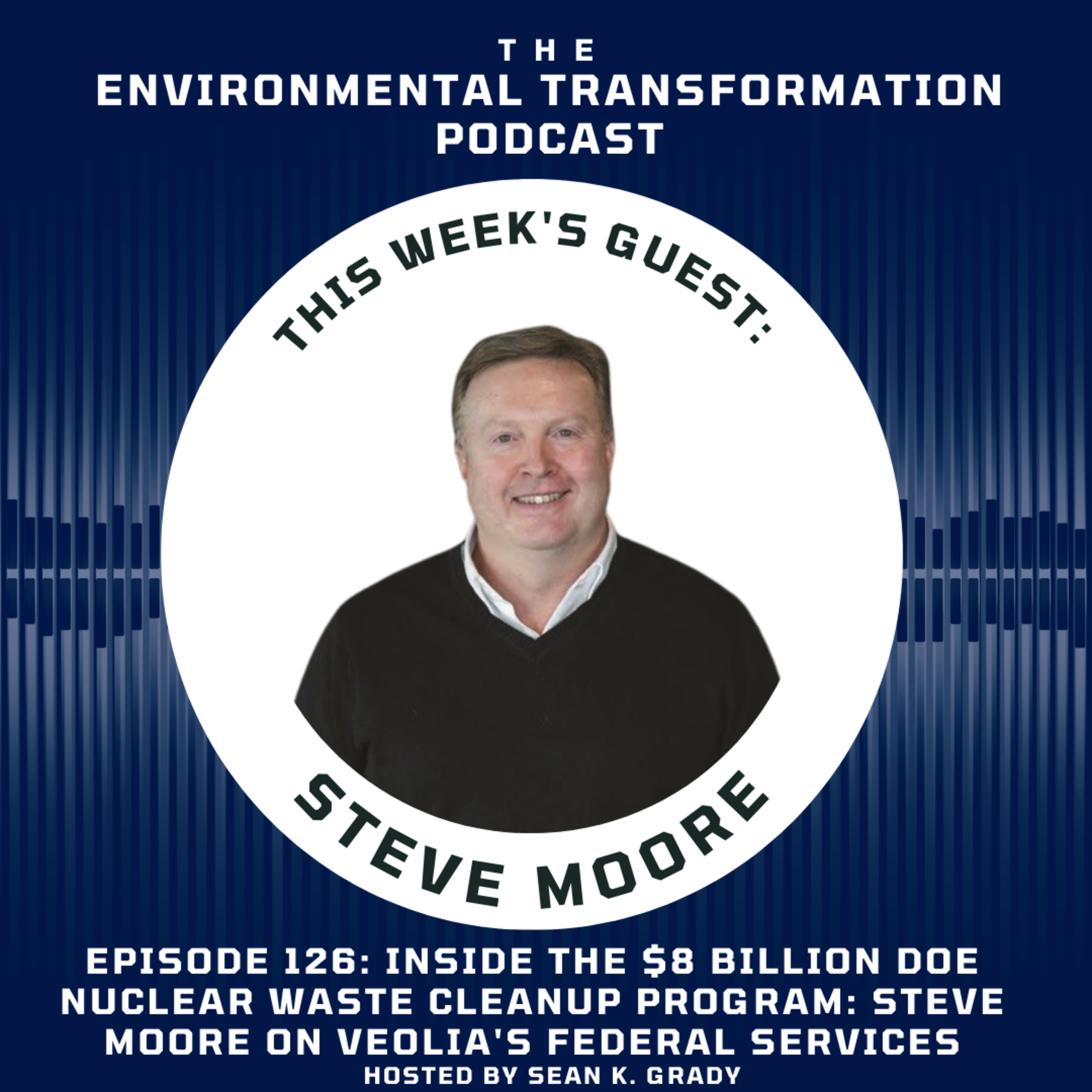
The U.S. Department of Energy spends roughly $8 billion annually cleaning up nuclear waste from Manhattan Project-era sites like Hanford, Washington and Oak Ridge, Tennessee. On this episode of the Environmental Transformation Podcast, host Sean Grady sits down with Steve Moore, president and CEO of Veolia Nuclear Solutions Federal Services Group, to discuss the agency's most pressing environmental liabilities and innovative remediation technologies.
Moore describes the scale of the challenge: 56 million gallons of high-level radioactive waste currently stored in above-ground tanks at Hanford alone. He explains how Veolia's patented GeoMelt vitrification technology transforms reactive metals and radioactive waste into stable glass, and discusses the company's operations of two of the largest radioactive waste landfills in the nation.
The conversation covers emerging opportunities to revitalize federal sites as data centers and advanced reactor facilities, the "competetition" model where contractors collaborate on complex projects, and why the nuclear remediation field offers meaningful careers for young professionals seeking challenging environmental work.
0:00 We all have responsibilities in light of that, but in the end these are complex problems. These are not stuff you wake up in the morning and say I can take care of 56,000,000 gallons of high level radioactive liquid waste. So you have to understand that it does take collaboration and it takes a lot of really talented people with a lot of lot of different perspectives. Welcome to the Environmental Transformation Podcast, where we bring you interviews with industry leaders, climate champions, sustainability practitioners, EHS and hazmat professionals making an impacting their businesses today. Each leader solving complex challenges and delivering solutions within their areas of expertise. I'm your host, Sean Grady, and thanks for joining us today.
0:40 Before we jump in, make sure to follow us on your devices and visit my website at www.seankgrady.com and sign up for our newsletter and e-mail announcements. Now let's get started. Welcome to the Environmental Transformation Podcast. I'm your host, Sean Grady, and today's guest is Steve Moore. Steve, the President and CEO of Veolia Nuclear Solutions Federal Services Group. Steve, welcome to the show. Thank you on it is a mouthful. It's not the easiest thing in the world to say, but I'm really happy to be here. We've worked together for a little while. This gives us an opportunity to maybe die in a little Prince. The work that the Federal Services Group does, in particular with our primary client, the Department of Energy, that's heavily focused on nuclear waste, which I think is a topic that your listeners bullhenge boy, but it's also your taxpayer dollars in action.
1:30 So keep that in mind when we talk about how much money gets spent. Absolutely. A little painful. No, this is going to be a good conversation. Excited to talk with you today. So, Steve, you know, tell us a little bit about yourself, how you got started in the business and, you know, how you became the president, CEO of Veolia's, you know, Nuclear Solutions Federal Services Group. Very good. So, yeah. So my background, I've got a chemistry undergrad. I'm an attorney kind of worked through a lot of the traditional government sites that people think of when they think of the Department of Energy. I spent a lot of time at the portable side, the the where they enriched uranium in Ohio built the relationship with the different companies and there's a lot of players that get involved in in this business. So over time I kind of grew into I work with Lockheed Martin at the time and and got advanced my career through there, started to work with a small business, had an opportunity to become an owner of a small business when a gentleman retired. So I had a business that that I grew pretty significantly in, in kind of 2006 to 2015.
2:33 So and we continue to grow. We had an opportunity to really look at the ways that we could give more people opportunities as we continue to serve this primary client and we reached a point where growth was really organically challenging. So we decided let's look for an acquisition and long, Long story short with a lot of different offers and opportunities. I, I got connected with Veolia, which is, you know, as you know, one of the largest environmental companies in the world sold to them in 2018. Part of that process was then used to create their business here in the US, in particular for the government, U.S. government. There's a lot of complexities when you're a foreign owned company and how you try to work for the US government.
3:16 We were able to do that through my acquisition and then I stuck on and help them continue to grow and have been working through that process ever since and it's been a lot of fun. Tell us, Steve, if you could a little bit more about the waste symposia. We're here in in Arizona. This is a big conference, probably 1 of the largest conferences I've been to. And to be quite frankly, I've never been to a conference with so many DOE contractors and service providers that are all focused on the nuclear yeah, business. Yeah, this is kind of their, I think they refer to it as their Super Bowl, if you will. But so the Department of Energy has a conference in in Phoenix once a year. And what we really are focused on, a lot of people don't realize is, you know, the US government, through the Department of Energy's Environmental Management Group, they spend about $8 billion a year cleaning up. Really it's, you know, for lack of a better term, it really is the Manhattan Project.
4:08 So I tell people, if you've seen the movie Oppenheimer, you understand our places like Oak Ridge, TN, Los Alamos, NM, right, Hanford, Washington, places where we did a lot of the research, rather a lot of the testing and everything associated with that, enriching the uranium, enriching the plutonium, and the things necessary to make that happen. So the government, you know, was all full steam ahead and and making sure that we had the what we needed to make that work. But the reality is there, there's a lot of work to do to clean all that up. So it remains one of the largest environmental liabilities that's U.S. government owns. This is the symposium once a year, where we all get together and discuss new technologies, new funding profiles, new things that are happening throughout the complex.
4:51 So when you're at this conference, do you have opportunities to interact with, say, the DOE directly? That's that's the real advantage of this. So there's a couple things that this is both a, a technical conference where there's papers and, and lots of presentations on some of the unique challenges of if they're waste, how it's packaged, how it's handled, how it's stored, how it's disposed of. But then there's also a lot of interaction from the department themselves. They're kind of listing their priorities as you would expect with new administrations with. Different. Things that that are important to different, different parts of the government, the opportunity for them to be here kind of say here, here's my top five things for this year, here's what we're worried about on the funding side.
5:32 So it gives us that real collaboration opportunity. And and you just, you know, when you get a concentration of people together one time, it's you got to take advantage of that because it's just, we're all busy. Absolutely it doesn't happen. Well, so why is this so important for BNSFS to be here here? And what do you plan to accomplish by coming to this event every year? Well, I think part of it too is there's a lot of this industry is pretty mature. There are a lot of companies that that are larger AE firms and different things that are really focused on helping solve this problem for the government. So for us in particular, this gives us an opportunity obviously here with a client, but also to work with our notice others to say, you know, develop those solutions, spend time with with people in more of a networking environment where we can really look at specific problems and specific ways to try to solve those.
6:20 Lots of follow up meetings and stuff come from this. But anytime you get an opportunity to get a bunch of, you know, really talented people together, you take advantage of it. And for us, we're really trying to hear or listen to the client, but at the same time, you know, engage with our partners and others to figure out what's the right priority for us. So you mentioned that there's opportunities to sit through trainings, education, but talk a little bit about some maybe maybe the opportunities where our people with B and SFS has to present to the audience about what their key experiences are. And so maybe technologies that we offer talk A. Little bit about that. So I mean we do a lot of things. Again the old is one of the largest environmental companies in the world.
7:00 So we have a lot of depth and breadth of capabilities. Not all of those obviously are focused on on nuclear waste, but in reality, a lot of the same type of waste issues that that people have rather it's landfill operations or it's treatment technologies for stabilizing hazardous ways. The technologies are are still applicable to what what we do in the nuclear world with this just it also happens to be radioactive. So for us, we've got folks that are giving presentations on, you know, everything from how efficient ways of managing landfills and the leach aid and everything associated with that to, you know, vitrification technologies that can turn a, a chunk of, of radioactive waste into a nice little piece of glass.
7:41 We just, we're going to talk about that. We are, we're not going to get that paper weight, not good. And then we also do a lot of things with, you know, as you, you would understand from radioactivity, there's a lot of robotics associated with that remote handle things where yeah, you simply can't get that close to certain materials without, you know, exposing people to health issues, issues that that that are not necessary. So it's kind of the full portfolio for us. And again, we can talk about it in in technical sessions, but then we can also meet with the client and and be proactive on what's the next channel. Well, I think it's a great opportunity to demonstrate our thought leadership and our expertise to the industry because, you know, what better way to talk about what we do than present in front of a lot of people, right?
8:28 And, and that's a huge asset to our company. One of the things I was hoping to maybe get from you is, you know, for the audience, what type of capabilities specifically are, you know, the BNSF group focused on and, and how do they deliver that? Because I think there's, you know, a little some maybe know exactly how or what you guys offer as a service. So talk about that group. So we primarily focus focus on on on waste management activities and you know that that kind of expertise. So if we have the full gamut of whether it's characterizing the waste, it's packaging, transporting and then we have technologies we partnered with some. There are two commercial radioactive waste disposal facilities in the US Most of the actual disposal facilities for nuclear material in the US are owned by the government.
9:18 So OK, we operate some of those facilities for them. We currently operate the two largest radioactive waste landfills that the government owns. 1 is in Hanford, Washington. The other is in Portsmouth. OH, that we're actually still constructing part of it. So we really have that kind of expertise. And as you know, deep in that's, yeah. And, you know, in your world, we, you know, Veolia North America does a lot of hazardous waste work. They operate a lot of landfills. Yep. So one of the things that we're really doing is we're partnering with some of the other components of Veolia North America and the hazardous waste group in particular will bring in their, you know, subject matter expertise on landfill operations in. We're sending our folks out. And it really is, it's a fresh set of eyes and it's part of our commitment to the client where we're, we're being it.
10:01 We'll bring in best practices and there's a lot of stereotypes about people doing work with the government and people don't work in a commercial environment. So what we really want to do is blend that together and, and take, take the best from both. So that that's really what we're focused on is, is kind of that those capabilities to kind of solve some of those unique challenges around waste. Well, I tell you, you know, the short period time I've been here, the capabilities that we offer is a full service that's like 1 Veolia concept. Right where it really is. Where we have water treatment capabilities, well, obviously we have our hazardous waste treatment capabilities. Whether we have, you know, we have 3 incinerators, we have a hazardous waste lamp. Oh, we've got 4 fuel building facilities for alternative hazardous waste fuels and other, you know, by products for solvent recovery and things like that.
10:49 There's so many great things we do, electronic waste recycling. Marrying those technologies and capabilities to what you guys do in the DOE space is a game changer when you think of the full package of federal services that we can offer any of our clients in the DOE space. And I think that's a powerful statement to anybody who listens to what we can do and get partnered for so. I think it's important to what we're seeing with this client in particular. So obviously we're focused on the environmental stewardship and all the things that are necessary to be the responsible stakeholder that we should be. But what we're seeing from this client is, is a big focus on taking these assets, the federal facilities and kind of revitalizing them there.
11:30 There's a big initiative from this administration rather it's a data center or it's additional energy capacity through advanced reactors or even through solar field. And I think again, to your point about 1 Veolia, we can you know, even RSIB group when it comes to commissioning new data centers. What we're seeing from this client is that, that growth opportunity where they're just, and hey, not only do we want this stuff cleaned up responsibly, but we're not just going to walk away from it. We, we want to take these assets that we own and we want to turn them into the next generation of, of, of productivity for. And right now the focus is certainly on data centers and whether it's our our water tech group or or SIB group, there's certainly opportunities for us to bring that one solution to to the client.
12:17 So when you're here, do you hear updates on, you know, the funding, Yeah, projects from the the DOE and how that's going to happen as part of their priorities? So one of my challenges with communications in in Beolia or or really with our staff or anything else is the never ending saga of government may shut down government may partially shut down government may open government may have a budget may not. And it's, it's we, we joke about it, but it's the same time it is challenging and, and I think anybody who would appreciate large projects realize that starts and stops and fluctuations funding create their, you know, their own set of unique challenges.
13:00 So for us, what we try to do obviously is, is as be as flexible as we can for our clients and see that, you know, that there's the pluses and minuses. Because it's not uncommon at the end of a fiscal year to have a surge where there was some planning work that didn't necessarily happen. And now the client comes, I've got some stuff here. So you know, we like to have stuff on the shelf and say, OK, here's 1-2 or three, right, if you feel like that's something you can do. So for us it really is about, I know Bob Capitol talks about being nimble, agile, right. And I think that's very much what is needed from client like this. And it's just a function of the government and it has its own set of challenges. Rather, you're trying to get in the line of TSA or, or you're trying to get rid of some nuclear waste, Eileen. It's still a challenge.
13:47 Hello ET Nation, I want to thank you for listening to the podcast. If you're enjoying the interviews we bring you, consider supporting the program by visiting my website at seankgrady.com and buy me a cup of coffee. Proceeds will go towards helping me continue producing timely content and offset production costs. I'd also like to take a moment and recognize a few of our sponsors of the show who have been amazing partners and our ET Nation legends. If you're looking for a drilling and environmental contracting firm to help you delineate the extended contamination at your site, then look no further than Cascade Environmental. Cascade has over 37 offices across the country and offers a huge range of environmental and geotechnical drilling, site characterization, and remediation services.
14:33 With their huge fleet of equipment nationwide coverage, Cascade is a great choice to support your environmental and infrastructure needs. To learn more, check out their Web site@cascade-env.com. That's cascade. Dashenv.com Hey, are you looking for an equipment rental company to help you with your next wastewater remediation or waste management project? E Tank is the only environmental equipment rental company in the industry that offers 100% guaranteed certified clean temporary liquid storage tanks at no additional cost. This protocol gives Peace of Mind for the previous customer by limiting their downstream liability. As well as the.
15:14 Future customer by preventing any cross contamination. For all of their rental. Tanks E Tank also runs a one-of-a-kind complete maintenance program for all rental items including liquid tight roll off containers, fluid transfer pumps and filtration items. The next time you are presented with an environmental challenge, call E Tank to come up with the solution for your problem. I want to thank one of our sponsors, Wastelink. Wastelink is the all in one software platform transforming how environmental professionals manage waste, connecting generators and service providers and disposal facilities in a way that is simple, connected, and transparent.
15:57 Their platform helps streamline everything from waste profiling and routing to inventory management and billing, giving you the tools you need to operate more efficiently and reduce cost. Whether you're a generator looking for better options or a service provider seeking greater efficiency, Waste Link has you covered. If you're ready to take control. Of your waste management processes and optimize your business. Visit wastelink.com to schedule a demo today. When you when you look across the landscape of DOE and their types of projects, are there any particular locations or, or projects that are like that is like the big one?
16:37 You know, that is like a major going to be here for a long time and there's so many opportunities for so many players to support the the remediation challenges. Which ones maybe stick out in your mind? So the one that's the biggest of the environmental liabilities within the CM program is and again it's a lot of people don't realize it, but from again the Manhattan Project and kind of end in the Cold War, there's 56,000,000 gallons of liquid radioactive high level waste stored at Hanford, Washington in above ground storage tank. 56. Million 56,000,000 gallons. It remains the single largest liability within the DOE complex, the current life cycle baseline projection, which is, you know, roughly around the end of the century, which is kind of code for us who've been in the business long time to say that's code for we really don't have any idea.
17:28 But in, in all seriousness, it, it's a real issue. We're very much involved right now with, with that client and not to, you know, bore people with too much technical detail, but there's, there's grappling technology, there's, you know, liquid separation technologies there. There's a big investment that the government has made with a, a waste treatment plant at Hanford that's been controversial because it has been behind schedule and over budget. So we're looking at, we actually just responded to a request for proposal to the client to provide some alternative routing technologies to help again, work away that in all seriousness, that's not gonna go away overnight. So it is a matter of kind of an all approach to how we can as a community of contractors work that down. But that's the biggest single liability that they have out there, right?
18:16 Now, so does the DOE have an end game strategy for the final disposition of a lot of this nuclear waste that's out there? I mean, Yucca Mountain was Swan there for a while, but now is there other alternatives that they're evaluating that's being hey, we're going to go this route or to some others, I mean, is there? So, so, so it's probably not as concrete as some people would like it to be, but this administration came out a few months ago with a request for information on a concept of basically, and I'll might mess up the terminology. It's kind of energy campuses or innovation campuses, or they're really looking at these, again, federal assets, these facilities and they're looking at a variety of different additional support services, consolidated waste storage spent for recycling. And then put as you make, you know, you, you recycle as much as you can.
19:08 Then you get to the point of where are we are looking at repository, the repository disposal. And that may be part of the equation too. It's a real issue. Or, you know, Finland is the host country here this year. We always sponsor a, a, a country to present and they are gonna go operational with their the repository for storage, for storage later this year. Really. So it's, it's not A and not the again, sound political, but it's not a it's really not a technical issue. It is a it is, you know, there's gotta be willing communities and there's gotta be that kind of stakeholder involvement for people to understand, you know, this is not something that's that's going to go away tomorrow if you're committing to do that. But I think the technology is there. I know the technology is there to do it responsibly, but I think that's kind of the next step. I know this current administration has aspirations for that.
20:03 But to answer your your other question just a little bit. So most of the sites individually, they do try to work a lot with the stakeholders to understand. Do you want this to become? In the Greenfield, do you want this to become right a new nuclear power plant do you want you know and really looking at the assets in the context of the communities cuz. They're like huge brow builds essentially, but much more complex. Much more complex, you know, from an operation standpoint, they're also huge employers and Oh yeah, right. Community. Grow up around. Correct. So what's the right answer for each one? It's you know, it's. It could be different. Wow, yeah, I can imagine. I mean, the complexity of trying to address all of these concerns, it's not easy, but you know, I think there are a lot of really smart engineers and scientists that are here working to all really pull the same direction to help DOE solve these problems. When you're here, you know how important it is for us as a company and you to develop partnerships with others that can deliver the full service of maybe a particular scope because.
21:10 We may be limited. In one aspect of our business, but you know to fulfill a full scope, we need a partner, correct. What is, how important is that for you and and what's our strategy around that? So I have. Not, I have not copyrighted this, but there's a term we all say in this industry called competimates, competimates. So we certainly have opportunities to your point where our technologies and services align with another company's capabilities to solve this solution and we partner and we do that. There are other times when you know we can do this and they can do this and we compete. But I think this industry has matured over the years to where the committed competitive a concept it really is true. We we all understand and we all have, most of us are publicly traded companies and we all have responsibilities in light of that.
21:56 But in the end, these are complex problems. These are not stuff you wake up in the morning and say I can take care of 56,000,000 gallons of high level radioactive liquid waste, right. Yeah. So, so you have to understand that it does take collaboration and it takes a lot of really talented people with a lot of a lot of different perspectives. Yeah, I just, yeah, I'm just, my mind's still kind of reeling on 56,000,000 gallons of, you know. Or, And remember, it's your tax dollars that are going to actually make that go away. So yeah. When come April 15th, realize what you're what what what, what you're signing up for there? Yeah, actually, I mean, yes, it's kind of no different than, you know, in the in the hazardous waste business. Or.
22:36 Solid waste business, each company can't really deliver all the services. They can deliver a lot of the services. And you know, we have channel partners just like you guys have channel partners to do, you know, deliver on service. And you know, we work together to satisfy and and meet the demand of our clients. And it's a great partnership when it's all working and communication is good. We need good communication with all our partners. And so we all know our lanes, what we can do. That's real important. If you could, Steve, talk a little bit about the actual capabilities that Viola has in this space and the types of work you're doing for the DODDOE industry because I don't think you know everyone understands it completely and and so.
23:17 Be happy to. That's it. This is maybe a little Segway to this. So just one technology we have, we have a lot, lot of patented technology. This is a vitrification technology that really focuses on obviously radioactive waste, but in particular waste that have reactive metals, sodium, lithium, those kinds of things. You certainly in your hazardous waste background know the challenges of of of reactive metals and at the same time throw in some radioactivity and it really does make it challenging. So we have a patented technology called Geo Melt. We have a couple of facilities, We have one in located at the Hanford Site and we have another one with a partnership with waste control specialist in Andrews, TX at their commercial radioactive wasteland. And what this technology does is it takes high level or, or low level waste that is also reactive and essentially vitrifies them in the glass.
24:10 These are electrodes that are sacrificial. And you typically see a combination of, you know, there's recipes with a combination of the waste and then surrogate material and then also the sand and the things to make glass. And then this is typically in the, you know, 1500° C range. It it, it's impressive, super hot and you end up with a nice big, a nice glass and then with that facility, then it goes to the land disposal in which it's no. Longer it's encapsulated. And it's the longer reactive metal it'll, it'll continue to be radioactive of course, but the the reactive nature of the D double O3 characteristic is is gone.
24:53 So that's an example. We're looking at this at the multiple sites. We use this with waste from Oak Ridge, TN with, with raised waste from the Idaho National Lab right now and are really looking at it similar to my earlier comments. You know, these are, these are unique solution providers and for us we're looking at those targeted things. The the waste, for example, we're doing in Oak Ridge, it, it's the sodium shielding that was used over 50 years ago to actually test the opportunity to build a nuclear powered Airfrag. So, so again, those are the things you get into and you realize there's something that's been in storage for over 50 years and now all of a sudden, you know, we have a safe, regulatorily compliant solution for that. And let's figure out a way to work that image way down. You know, I think this is such a great example to showcase the technology for somebody just coming by the booth or just curious about what is the end result of a GO Melt product for the listeners and and those watching. I mean, this is an actual block of I think concrete here, but inside is the hot radioactive material and then it's encased completely into in a glass through this melting Geo melting technology.
26:17 It it's pretty fascinating. I think it's really great that this is a a solution that is eliminating your radioactive exposure by encasing it in vitrified type container. Is it safe to say though this like this is our technology, but there are other companies doing similar, yeah. There are product side delivery, yeah, a lot of it has to do vitification as a technology is is a common in the hazardous waste world certification using, you know, different types of material to be heated up and and encapsulated. That's what you're doing. So, yeah, the patent here really is related to the method and this is a batch process, not a closed loop process. And kind of the way we have sacrificial electrodes and that approach, it's a proven technology. It's rather robust.
27:05 We configure it differently depending on the size and then the end state if they needed, hey, we need this it to be end up in a drum, we need this to end up in a box and we have the flexibility to do that. And to your point of there, I got I got some engineers who could they could do 2 podcasts on, on on how the well we'll. Probably talk to the We'll get Rob Mitchell out here at some point. They'll leave me behind pretty quick, right, right. Really passionate about this technology. No, it's, it's really great. And, and, and to see, you know, kind of like the actual results in the, you know, technology right here in front of you really kind of brings together the whole concept. And so it was really good to learn that this week for me. Yeah, as a as a.
27:48 Partner with you. The other nice thing we've done with this to echo your point is we've taken the DOE client to the facility and you know, it's the shows them and models and and PowerPoints are cool, yeah, but you stand there and you see you know this is how it happens and there's the end product and and everything else in it. Again, the other thing I would say is that was a investment that Veolia made in a facility where we didn't actually have a backlog and a long term contract. We saw the need, we understand the long term issues of the client. So we've proactively developed this facility and are now this room where we're doing the podcast. We've had half a dozen meetings this week about how we can continue to to solve these challenges and problems that that this technology helps. So how big can these encased, you know, GMO products? I mean, how big?
28:37 Can they be, so, you know, there's theoretically, you know, lots of different scenarios, the kind of the, the sweet spot size is a 6 by 6 by 8 box. And that's kind of, that's kind of what we've got set up. Our facility in Texas also has the ability to have, have two units and it's rail aligned with rail to where you move one box in, let it cool, move another box over here and, and be able to, to configure it that way. But it is a, it's a flexible technology. And we're actually looking at, one of the things we're looking at somewhat unrelated to the kind of the nuclear waste world, is that there's a lot of classified shape or associated with weapons programs and things in the past. And, you know, what needs to happen is those shapes need to be destroyed before they're disposed of.
29:23 And this is something that we've been in discussions with some of the security people. It's kind of interesting because we don't know where they are, how many they are or what they look like. But we know they're shapes. So. So we're working with the client to see again, because the technology makes sense and and the application for it would be again different from a radioactive standpoint, but it is, it's a really cool technology that can can do a lot of different things. This is, it's, it's, it's great. You know, when, when you're here and you're looking at everybody and you see all these partners and there's just so much happening. And then, you know, one starts to think after you start to learn about what the DOA strategies are and things like that for, you know, addressing their big challenges, how does that help you formulate your growth strategy for our support of the DoD or I mean DOE and and how we grow our business throughout the US? Yeah.
30:17 So I think a lot of people don't necessarily realize, but you know, the US government is the largest single employer in North America, right? They have the most facilities, the most real estate, the most fixed assets. So for us what we're really wanting to do is our growth strategy is really wanting to focus on how do we bring the full portfolio of services of Viola North America to not just the the part of energy client, but to the government because we have that full capability. And as I mentioned earlier, you know we have as being a four known company, there are certain things that we have to do a little differently still for the US government. We can do classified work, we have clearances, we have those kinds of things.
30:58 And in order to do that, what we want to do is, is align ourselves with the government in general because of the growth opportunity there. And like I said earlier, bring the full capabilities of Veolia North America to the client. Some things are going to make more sense for the Department of Defense, some of them make more sense for maybe NASA or some combination. But we really believe we've only scratched the surface on what we as a as Veolia can do with one Veolia with the largest employer in North America. Well, I think it's really it's powerful statement from our company that really wants to focus on the growth of our federal business. You know, you mentioned some of the things that you guys are doing like you know, you're a mitigated entity within our own company so that we can actually comply with all the FAR requirements and the CMCACMMC, you know, cyber security requirements and cost accounting and things like that. And us as a company can work with you. I mean us meeting our environment or has waste business can work with the federal business under the same umbrella.
32:00 Yep. That's a that's key because now we have the flexibility to really deliver that full one, the only approach and so can our water business and so can yeah, I mean it's, it's really, it's really a great opportunity. And I think too when you look at bring up you look the initiatives that that are so important to Paris and as we continue to move forward is right. Again, this is a bit of an untapped market in that sense, right, That the US government market is, is, I used to joke with people, it's the, it, it's in your 4-O1K, It's, it's the stable growth fund, right? It doesn't get you jumping out of bed in the morning, but it helps you sleep a little better at night, right? And, and, and I think that's what it's a. Steady, constant, slow.
32:41 And I think for for a growth company like Veolia, I think some time spent working through the never ending challenges of working for the federal government is probably going to be worth it in the end. Well, I, yeah, I agree. So it's, it's really exciting times. I think we're in just a kind of a new era, so to speak with the new administration. I think it's going to really develop new opportunities that we haven't seen before. I think there'll be an emphasis on doing things quicker, yeah, rather than slower and less process red tape versus let's get going and do it. Have you heard feedback in that space? I mean, it's definitely the, the mantra of this administration and, and having done this for over 30 years now, there's a little skepticism from any administration change because again, great ideas and great initiatives we all support. But you know, we like to joke that, you know, the, the federal government, Department of Energy in particular, it's, you know, it's a bit of a battleship, right? So moving, moving and in most cases, administrations have windows, windows of opportunity, but this administration is clearly committed to the things you just said. And we're seeing, we're seeing tangible results, right? The data center developments at these sites and the conversations earlier this week where you've got a, a commercial data center coming in and they're saying, Hey, I want to have access to this site by this day, right? And you know, knowing that if you, if the department doesn't say yes, they're going to go somewhere else, right? So, so I think we're seeing some
34:14 of that and I think time will tell. I think there's momentum that's being built that these are things and, and again and again, it's always a balance, but with the regulatory framework, the decision documents, the records and decision, the circle of sites there, you know, there's a huge environmental envelope of safety and and care to the communities that very much intact, not in any way being circumvented. You know, it's just we're trying to figure out ways to be nimble and be flexible while we're still protect human health and the environment, and we're seeing all that happen. Well, you know, one thing that I've after we have a bit of some aging population in our workforce. And what would you would say to a young professional just trying to break into this space who, who is attracted to say the DOE market space?
35:00 Because I can tell you from experience, the DOE market environmental space is a little different than the industrial commercial environmental Azure space. And so, you know, you're, we're all working in the same kind of mission to protect and human health, the environment. And, but they're different, you know, industries in the South and it's, it's how, what do you recommend for somebody? I spend time with with the own panels with college age kids and and others and, and it's you know, what I describe with this industry is, you know, it's complex and I think for people that really want to be challenged and really I pry into the the we are cleaning up the the challenges of the past.
35:44 Right. And since the past is what A? Lot of people would say it's a noble mission and there were great reasons why we did what we did. But I think again, we owe it to the country and those same communities that sacrifice to make all those things happen, to really do what is right by them. And and it's a noble cause. And the other part of that for younger people is, I don't know, a market that has as you know, as many challenges. So there's unique issues with, with types of material, with waste. And as as the program matures, you know, it's only the harder stuff that's left. So if you want to be challenged and you want to really feel like you're having an impact that is generational, it's, it's a good industry to be in. It is, it's also what I'm seeing with this administration is their ability to then look, cuz you know, the theory in part was where you're just working yourself out of a job, but with what they're wanting to do, developing, redevelopment or something else, you know, you're just. You're more jobs.
36:42 You're just moving it forward, right? You're bringing in a modernization approach to different things, and I think that's really exciting. Well, that's great. That's great. Well, Steve, really appreciate you coming on the show today and talking a little bit about what you know BNSFS is doing and and how you are helping clean up the DOE sites that are around the the US and really excited to see what happens in. That it's the exciting time, but anytime there's a hint of a government shutdown, please pray for me so that that would be appreciated, that appreciate the time and enjoy talking to you always. Absolutely. Thank you, Stanley. Thanks for listening and watching the show. If you enjoyed the show then please share it with your friends and Co workers on social media and tell somebody in person.
37:24 Thanks for being with us, ET Nation.

CEO
CEO of Veolia Nuclear Solution Federal Service and been in the nuclear business for over 30 years. Prior to working at VNSFS, Mr. Moore served as President & CEO of, Wastren Advantage, Inc. (WAI) from 2006 until Veolia acquired it in 2018. Under Steve's leadership, WAI grew from a regional firm with less than 50 employees to a national company providing products and services around the globe.
Steve is on the board of several non-profit groups that support economic development, innovation incubators, and health and welfare providers. He is a founding member of the Tri State Angel Investment Group which is a private equity fund established in 2015 to focus on investing in companies in the Southern Ohio region.
Steve has an A.A.S in Plastics Engineering Technology and a BS in Natural Science from Shawnee State University, a Juris Doctorate from Capital University Law School, and completed an Executive Education program at Harvard Business School. He is is a member of the Ohio Bar Association.


