

 Apple Podcasts

 PocketCasts

 Spotify

 Overcast

 TuneIn

 RSS Feed

 YouTube

 Amazon Music
"Forever Chemicals" Environmental, Economic, and Social Equity Concerns with PFAS with Authors LeeAnn Racz and David Kempisty.
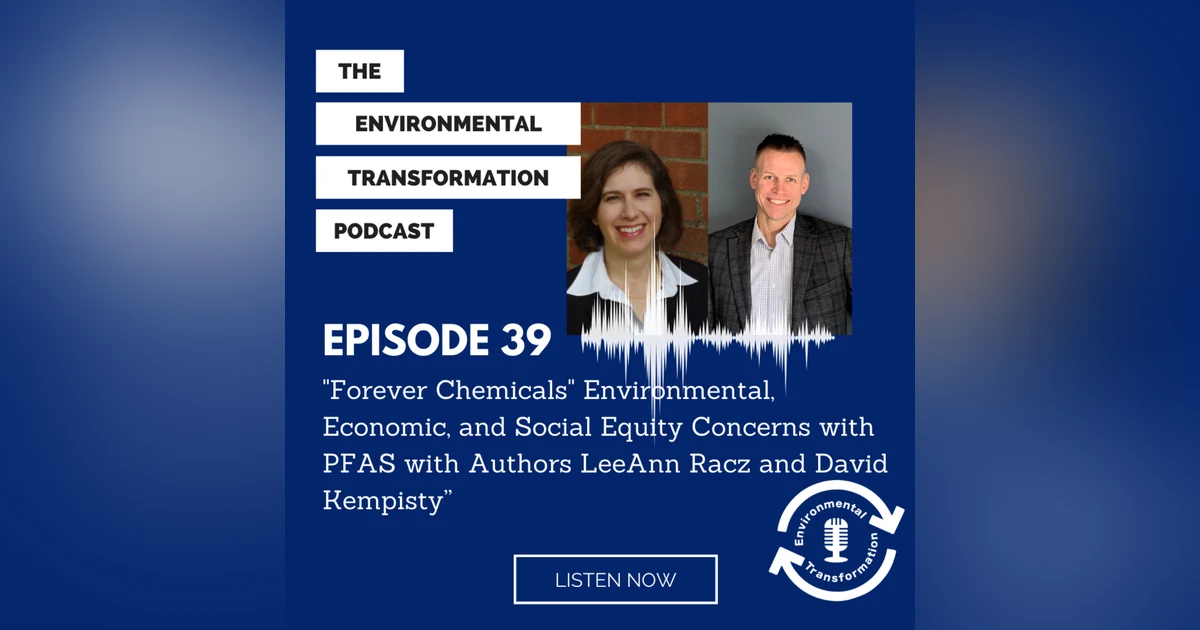

Forever Chemicals known as PFAS, are a class of man-made per-and polyfluroalkyl substances that persist in the environment and don’t break down. PFAS chemicals have been around for over 70 years and have been unregulated by the EPA for decades. Authors LeeAnn Racz and David Kempisty document in this book, "Forever Chemicals" Environmental, Economic, and Social Equity Concerns with PFAS in the Environment, the challenges with analytical testing, risk assessments, regulatory implications, consumer products containing PFAS, waste disposal, remediation concerns, and more. Check out this informative episode.
Thanks to our Sponsors: Cascade Environmental, Terra Nova Solutions, and E-Tank and E-Pump.
0:03 Also, for example, just last month, the House of Representatives passed a few fast action act, which would require the EPA to add fifo and P Foss to the list of hazardous substances and also assess other PPS to determine why they should be designated as hazardous substances and under cercla. That's nice. This nation has, its hazardous substance would trigger certain actions for remediation, clean up for a sites that are attacking my it's coming then Coming out. Yeah. Oh, so that proposed legislation has now moved to the Senate, so we'll and then we'll see where that goes. But again, that is that again, that 2020 ndaa that prompted the EPA to require the EPA to add several P fast to the Toxic release inventory. Now, it's kind of a high number now. So, if you notice is popping up a trigger very easily, but also then published guidance on how to store and dispose of P fast, this is States was helping us Implement health risk. So there's lots of movement in this area. Sure.
1:00 Sure. Welcome to the environmental transformation podcast where we talk with industry leaders, climate Champions and sustainability professionals, who are making an impact in their businesses. Today, each leader solving complex challenges and provide Solutions within the respective areas of expertise. Here's our host, Sean Grady. Hello listeners. Do you have your environmental transformation podcast, sticker yet? Well, I'm giving away. Free ET podcast, stickers to those who contact me via my website at www.shawnacoronado.com, so send me a message to receive this cool.
1:47 Looking sticker to proudly, show your support of the podcast, then post up a picture on Instagram LinkedIn or Facebook and tagged me to help promote the show. It will be fun to see where everyone puts their stickers, and I'll put mine on my water bottle and my laptop. So what are you waiting for? Get your sticker today. Welcome to the environmental transformation podcast. I'm your host Sean Grady and I'm bringing you interviews with leaders in the industry. Providing you information about industry Trends in climate change, Future Energy circular economy, regulatory topics and providers that are transforming the industry. And today's guests are Leann raised and David Kemp St, authors of the new book forever.
2:31 Chemicals, the Economic and social Equity concerns with pfos in the environment. How are you guys doing today? Great, thanks for having us. Well, I'm very glad you. Yeah. Thanks the glad you guys catch. Come on to the show today. You know, I've read the book. Most of the book, really great information here about the, the pfos. Let's talk about the book. What did you guys release the book? It came out on the street last month. Late July with Taylor Aransas. Yeah. Okay, okay. And so let's talk a little bit about the the topics that are covered in the book. Give us a little, the listeners idea.
3:11 We'll all the various chapters and you know components of the book that you're of the material you're covering. I think that one man. Sure. And so I'm really we look at P fast. It's a fascinating topic and it's a dynamic topic. And so we try to present in the book, all the different challenges, and how they're intertwined and progressing at different rates, but affecting one another. And so we look at from a regulatory perspective, how things are evolving at the state level, some of the things that are going on in Europe, but that's being affected by how low Limits of detection can be founder or what can be found or what are the approved method of there?
3:52 Were some of the analytical concerns. And so that's the second area that we talked to is the analytical challenges that are associated with these, but the regulations and the policy are also afforded, you know, need input from the toxicology and how that toxicology is effects affecting things. And so what are the adverse health effects of these? Chemicals are, what are the concentrations? Where we'll find some of these points of departure to Health outcomes that we would like to avoid. So that's changing. And then finally, how do we clean things up or how to remediate things and there are a variety of different Technologies to remediate or, you know, do they destroy them, or do they just transfer them to another medium?
4:33 And then we've got to deal with it in a landfill or incinerated. So all four of those areas really are moving along and progressing but they're all affected by one another. And we have chapters kind of talking to each of those points. Man, this is like an onion. We A lot of layers to uncover here. Don't worry. I mean, there's a lot of detail in here. And so before we jump in, you know, let's give the listeners a little bit of background on you too. And how did you guys become, you know, quote unquote some experts in the field so to speak with pfos chemicals and give it. Give it a listen a little bit background about each of you. So, both David I have had careers in the Air Force.
5:14 We were we, that's where we met. That's we work together. As Air Force officers and bile environmental Engineers is what their career field was called where we were basically environmental health professionals by my lack of facial Health. We are environmental Engineers. We also industrial hygienist and anything to do with human health, exposure to occupational, environmental stressors, chemical biological, radiological, physical. That's what we. That's where our expertise life and then If you can talk about your, your graduate work, that's kind of what you got into that into the pee fast Niche. But you know, this is a topic that's that is pervasive and it's something that we're all dealing with this time.
5:59 So so we all have a vested interest in this topic. Yeah, Shawn it was a pretty fortuitous happening for me and that I was getting my PhD at University of Colorado Boulder and I was studying carcinogenic vocs and a different absorbance and running this Allure experimental apparatus in the lab and Colorado School of Mines was working on these chemicals pee fast chemicals and they were having issues with their RSS. CT and they asked me for some insight and we went back and forth and then at the end of the conversation they said you know Dave you've got that truck. Why don't you just go ahead and go clap the water and we'll just go ahead and do that research here and I think and I don't even know how to pronounce these chemicals. What I don't want to do any more work. I'm trying to get out the door here and Funny part, is that beef asses, you know where I make bread and butter today and nobody looks at my dissertation for carcinogenic vocs. It's more of the work that I was cajoled into doing begrudgingly but hindsight's 20/20.
7:02 Well, there are probably some learnings you can bring over from the vo C carcinogenic side of things with pfos cuz there's definitely some health risks there right with the curvature. Yeah. And then with the adsorption and activated carbon and it's one of the The core remediation technology. Certainly applicable to both of those contaminant classes. Absolutely absolutely. Well, I mean I really love how the book just kind of broke down. You know, bite-sized digestible, you know, sections so you could really like, okay. Let me, let me read this one about, you know, remediation or let me read this one about analytical and and you really you broke it down really well. So for the listeners, this book is hugely informative. It's very educational and it's Timely because it is bringing up these topics that are current status of the, of the, the State of the Union.
7:55 So to speak of pfos situation. At least that's the way I interpret it. Is that kind of what you intended it to be guys. Yeah, actually, this was our second book on pee fast. We had one when it came out a couple years ago, and and they've give me a call me one day. So, you know, we have more to say there's more to work to be more things to be said about this because research was just developing and coming out, As such a rapid pace and we're learning more and more that we need to get this word out. So, so that's kind of the Genesis of this particular topic. And I do want to say also I do I would be extremely remiss. If I didn't acknowledge all the wonderful work from are contributing authors, we have some world-class experts, no kidding! That, that contributed the chapters, many of the chapters, to this book and and they really made this River Valuable project.
8:50 Well, that's good. I mean yeah. You know how it is. I mean it's a team effort on just about any good project you work on and hardly anybody can just do everything by themselves. So it's great that you're able to, you know, give some shoutouts to the contributors. So, you know, there's a lot of, you know, top talk about pfos and a lot of mystery about it and a lot of wondering what's going on. But you know, let's talk about, you know, what are the various Pathways of exposure for pfos. I mean Why is it such a problem? And you know, what's the challenge with all these exposure pathways? Yeah, I'll start in the maybe David can chime in too. Now, these compounds are used in so many products, that mean, you're, they're just all over all over the place and textiles and all kinds of Coatings and firefighting films, of course, but because they don't degrade in the environment. They're going to find their way to all kinds of different pathways.
9:54 Historical pee fast, manufacturing, waste and product. Use have been direct Pathways, but also, there are many indirect Pathways. When they end up in landfills, they can migrate delete shade and landfill air emissions. They can also be sent to wastewater treatment plants and of the water cycle. And then, of course, enter surface water and groundwater. And we're also learning more about P. Facet indoor dust in the atmosphere so multiple different Pathways, okay? Right. And predominantly. They, they show that the greatest contribution and Simone. Balan wrote an excellent chapter in our book and kind of taught lays this out very nicely in one of the chapters.
10:35 But she talks about Holly the greatest contribution seems to be from food and that's been cited, repeatedly with various studies. But if you're in a contaminated Community, if you have a release of these, or you're next to an aviation Community or wherever there is, Contamination of these, not widespread contamination, but, like a point source. Then it's the greatest contribution. Like 75% of your intake, is from a drinking water source. So it really depends and if you know, and then there's various studies that show children have greater exposure from, you know, because they're on con carpets that are treated with these chemicals that they can have a greater exposure to that best and these consumer products.
11:22 And so, There's a variety of different ways that we can be affected by these but you know, their W perfect of around the planet. Well I mean So currently there's no clear federal policy coming right away. I mean, the states are the states seem to be, you know, left to develop their own criteria, their own standards, you know, is this a good idea? I mean, I know that the federal government is working towards, you know, a policy of some sort of a standard, but it's still a little years in the making in a sense. So You know, is it a good idea that the states are moving forward with their own? You know, standards before the federal government comes out with one? What's your take on that?
12:07 Yeah. Go ahead Dave. Yeah, it's very complicated but with regards to the provisional Health advisory and now the Lifetime Health advisory put forth by the EPA there, that's in fact like a like a de facto regulation but there is no Safe. Drinking Water Act regulation for these or other air emission regulations out there currently from a federal perspective. So as you said Shawn, the states are moving forward. Is that a good idea? Not entirely. Because now you've got Have individual toxicology, tests and development of these standards and then defense of these standards and then you're left with the scenarios. Why you're, you know, monitoring six of these, this Suite of chemicals in one state and eight and R2 and another. And, and so you'd have a patchwork of regulations. And so it makes it much more challenging, whereas if you had one Federal standard, then you could tighten the regulations if you would like, the states are still obviously allowed to Maintain their Primacy and go that route, but you would, at least have one consistent study to base things on a bass line if you will to move forward.
13:17 Yeah, that that seems to be what I thought, too. Lee Anne, you want to contribute more than that? Well, Dave's totally right. Yeah, you talk about this Patchwork of regulations and that's exactly what it is because you know, as you mentioned in the absence of any kind of Federal Regulation that states are left to their own devices and that's 92. Very, there's a whole Spectrum, some rely on the 70 parts. Per trillion, Health advisory limit for people, and be false and others. Who said, you know, we think 16 part per trillion is safe and other one says, 40 parts per trillion is safe, so it's very confusing for the consumer but also for our for professionals as well. But you're right. The tide is starting to turn. There's been some regulations that have come out that have been enforcing the EPA the federal level to make some decisions that is going to take some time. Yeah right.
14:04 And in some states are actually A just regulating to specific compounds to not just, you know, a class, right? So that's a problem or a challenge. Should I say I'm gonna be a problem, but a challenge, right? Yeah. I mean, I think that the class regulation is a worth investigating, but you're having again, that's just more of the patchwork, right? So not just a numbers, not just different, individual pee fast, but now you got families of P fast. And then, on top of that, you've got different notification levels, are you have to, you know, three strikes and you're out and now you have to make Suspension, the newspaper but a different state has a different penalty or consequence or how much do you sample? How often do you sample, all these sorts of things are different for each state and so, it makes it very challenging. Yeah.
14:48 I mean, I look at this and I go, wow, you know, there's a lot of states that are kind of leading the charge with, you know, California New Jersey, Michigan. A few of these others that are really kind of, you know, they're definitely in the, in the lead, with regulating or at least putting some standards. Out there for industry, you know, I got a magic if you're if you're in the industry and you know, maybe you're one of the contributors unfortunately or you're in the federal government, you know, keeping up with the individual state requirements and having professionals help you. I mean, that's got to be just, you know, a very difficult proposition. Well, the Department of Defense has one good candidate that that you can cite because they have installations across the continental United States or across the world. But they've got to understand what this past work regulation is or do they just go by default to the the EPA number which is a provisional Health advisory?
15:44 And now that's a brokered agreement because it's not a true, not a true regulation in the Lifetime Health advisory excuse me. But yeah, makes it difficult for for Planning programming and budgeting. If you're having these new standards come online, you know, the military wants to have some sort of prescriptive number that they can follow and they can understand and put an estimate to how much this will cost them and then be able to act accordingly. But when you have this this mishmash and it's much more difficult. This episode is sponsored by terranova Solutions specializing in Industrial Services remedial construction and waste disposal services throughout the Northeast Mid-Atlantic.
16:30 And in the Southeast regions of the u.s. with locations in Upstate New York, North Carolina and South Carolina. Terranova. Provides proven remedial Technologies. Customized Industrial Services and total waste manager. Programs include both cell performed and third-party waste disposal terranova, screws perform both routine. And The contest real service level project engagements for top-tier clientele on the East Coast, their staff are seasoned professionals and travel routinely to most locations in the US. Give terranova Solutions a call today at 315 359. 1308 or check out their website at www.solutions-recovery.com for support on your next project. You know, when I look at this and I'm thinking, wow, okay, pfos is like the new, you know, the new Vapor intrusion pathway assessment, right?
17:28 Like if you're in the remediation business and I've been involved in the remediation business for many years when, you know, the vapor intrusion came out, I was like, oh gosh, we got a. We got to go back and test and reassess all our sites that we had, you know, previously closed because Vapor, you know is a pathway. We didn't rude. Assess, you know, from a toxicological or health risk assessment process. But now, I'm looking at this going, pfos is going to be the whole new wild wild west of this because, you know, it's not been something anybody's been looking at. You know, what do you guys take on this? I mean like, okay, so for instance, is this going to, you know, effects like say the atsm, ASTM appropriate inquiries Rex.
18:12 So we're going to start adding this to you know, our Phase 1 reviews to SS properties because pfos is, you know, going to be a huge remediation Target. You see that going that direction? It's certainly possible. I mean, everyone's kind of jumping on the bandwagon with regulations right now, the 2020, National Defense, authorization act ndaa, had required the at the federal level, a lot of things to happen and that's moving in that direction. Also, for example, just last month the house Representatives passed a few fast action act, which would require the EPA to add fifo, and pfos to the list of hazardous substances and also assess other PPS to determine why they should be designated as hazardous substances and under cercla.
19:01 Designating, this nation has its hazardous substance would trigger certain actions for remediation and clean up for our sites that. Are you talking about? It's coming, then it's coming. Yeah, so that proposed legislation has now moved to the Senate. So, we'll and then we'll see where that goes. But again, that is that again, that 2020 ndaa that prompted the EPA to require the EPA to add several P fast to the Toxic release inventory. Now, it's kind of a high number now. So, the notice is up enough, a trigger very easily, but also then published guidance on how to store and dispose of pee fast, this is states without testing human health risk. So there's lots of movement of this area, for sure. Yeah.
19:42 David you have any thoughts on that? It's just that it's Continuing to bring what we're all talking about here more attention to the issue. So it's not just safe drinking water but now you're bringing it into a hazardous substance. Now you're tracking it with Toxic release inventory. He's so you're just again expressing, the, the issue to the public and promulgating further action, but but you're also having a way of funding this if you get a hazardous substance that designation. So now you're open to cercla and super fund funding mechanisms. For some of these sites that are affected so you know, good and bad but just bringing more attention to the issue.
20:23 Yeah, I think there's gonna be a ton of, you know, I guess legal fights and civil cases are lawsuits over this over the next few years because the magnitude of investigation that will take place to assess pfos and kids, you know, at properties is going to be huge. And I think the big challenge that the EPA is going to have is Is that they really don't have any any that they, they don't have enough approved. EPA analytical methods to really test for these, these chemicals. And we don't even have enough to really cover the gamut of the full spectrum of pfos to chemicals, right? Absolutely yeah, yeah, that's true.
21:04 In an earlier podcast, I know you went you interview, Terry McKnight, who is the best practice leader at your orphans and she contributed a great chapter on analytical methods in this book and yet, I think every Colin that that interview and interesting, the book she talks about how the development of these analytical methods and until just as recently as 2018, there was really only one analytic methods of drinking water and then we had another method that updated it. And then we have that at targeted more compounds. Now we have some, a couple of methods for Long training, short chain. And then we have these, homegrown sort of versions is user-defined methods, which are not. Italy validated at a third-party standard for other matrices but that's, you know, little other level of complexity with measuring from the soil and Wastewater sludge and other snow solids.
21:58 Yeah, are I mean now there's there's a lot there. Right? Right, right. The one point I would add to that though. Is that there are defensible methodologies for understanding these chemicals from an analytical perspective, but there are not the EPA approved methodologies and so that makes it challenging. Challenging. But so we do have the technology to get there. We just it's driving cost, then you have to investigate it with each and every lab it's not inter-laboratory verified and certified the quality control and quality assurance. Measures haven't been you know completely approved or agreed upon. So we do have methodologies that are defensible. It's just not easy and you have to kind of do more work which cost takes more time cost more money. Yeah, yeah.
22:44 I mean the sampling Cost from Inland a little perspective are going to go up, right? I mean for everybody you know the ability to detect down to parts per trillion and and and tear and mentioned Chic, they they believe they can get down to parts per quod trillion. They're seeing particles that low. I'm like, are you kidding me? I mean so, okay, so the questions like do we have enough Labs that it can actually even meet these standards available. Political detection at a reliable rate with, you know, a proper method detection limits and and and you know, qaqc and all the verification that needs to be done to run the samples.
23:28 I mean, I'm concerned that we don't have enough laps in the country to do this appeal. Support the industry with this type of sampling requirement. I mean, what do you guys think? Go ahead. Dave that's one of the arguments for monitoring or regulating these chemicals as a class or as a grouping or, you know, some sort of toxic equivalency something along those lines where you can have those methodologies. Like the total oxidizable precursor methodology, where you're changing these precursors into stable and states and trying to get, like a total P, fasts kind of understanding, but, you know, there's Weaknesses to that argument as well because now you're just kind of lumping everything together, but that does avoid the issue of what you just brought up Shawn as well as not having toxicology for, you know, these hundreds and thousands of chemicals. You know, we've really just got adequate talks on it on a handful of them, but if you regulate them as a group and we try to understand them, then we can probably try to get our arms around them sooner rather than later and waiting for talks on hundreds of these Right, right.
24:43 You know, the the since the analytical detection limits are so low, you know, there's a lot of potential cross-contamination since this stuff is everywhere, you know, it's you pick. What is the environment? It seems like, you know what types of advice or do you guys have for people that would be in the, you know, in the mode of hey I need to go collect some samples and do a effectively so that they're not, you know. Biasing the sample. Yeah, it can be a little tricky because, you know, if you have anything lined with Teflon, then you have P fasten your sample, right? Oh so good collection procedures, good handling procedures, making sure you account for background.
25:28 All those kinds of good practices are really important and coordinating with the lab to first. I mean this is you know collection was sampling. 101 is called a lab first, make sure that you have the right kinds of sample means And follow their procedures correctly. Yeah. Well as we talk about these types of pfos and there's all kinds of them but you know one of the big issues that's kind of come up. That was like Hey firefighting Foams a triple f is that the big is the big culprit? You know, least that was one of the, you know? I mean, it's not the only one but it's a big one, right? How much is it? How much of this stuff is out there? Still that contains these P. Faucets chemicals. And are there any good? Natives to help, you know, fight fires with different types of chemicals that are you know, as effective. There, there are, there are some some good pretty good Alternatives and they're being developed still. But you know, this isn't necessarily something new this back.
26:28 In the little go, a little little history, some because just to demonstrate that, this is not something that we're facing brand-new back in the 60s to the 80s, firefighters train with the real, a triple F, but then they found that, you know, there was still it because it's such a good foaming agent attended. Stay and hang around, secretly do weight more the more than one training event a day. So I had to find something else they could get was more training in and so they found that if they had these fees remove the flooring from the from the Foams they could sell it, still behaves pretty well. But without that that foamy action that had around very much so that he was training films and the training films have been around since 1985.
27:09 So now you have these floor and free phones that have been around for some time, That are sitting on the background ducati's. Italian motorcycles. There you go. So, so so these flooring free films have been around for some time. And and industry has been working. Really hard to develop some, pretty good Alternatives and and they're out there, they're on the market. There's also some good certification initiatives out there to to certify that, whatever you're introducing you're placing back on the market. Whether it's Something completely free of fluorine or something else has is not introducing, something else.
27:53 That's going to cause US problems down the road, know, and love, and at them consequences. So, so there's been lots of development of work in this area. So I think, I think we're industry is going to, to find a way around this. And so, some of the aviation communities. I know London Heathrow is already switched over to a file, flowing, free foam. So, there are there is a move afoot. I think some of Of the specifications are written for the Federal Aviation FAA, as well as the military specifications require fluorinated surfactants in there. And so that's some of the challenging challenges with bureaucracy or are getting around some of the, some of the rewording, some of that or understanding that these flooring free Foams are just as effective.
28:39 And there's test data to show that. And so summon, European Community are a little ahead of us in that regard. And then, Also more kudos to the Department of Defense, their standardization, or their specification, might be outdated, but they're putting a lot of effort in through sirte Pandey. Stcp these major research funding mechanisms of the Department of Defense into development of these flooring free phones and they've got multiple initiatives underway that are producing data to get after a fluorine free phone. Yeah. And so I also added in a whatever an organization chooses to use and how they choose to go. This, it really is be made by.
29:20 I'm also, the multidisciplinary team needs to weigh on this on this issue because environmental regulations are moving faster than the fire code and and what is, so you need to have the environmental engineers and those that understand those regulations and how that develops along with, the those that actually understand the delivery mechanisms of these Foams because the formulation is going to change, how it's delivered. They all have to work together. Yeah. No, that makes sense. That makes sense. So, you know, many of these chemical companies are discontinuing continuing the production of the see, a pfos chemicals to some shorter carbon chain. For C-4 carbon chemical. I mean, so do we have enough toxicological information that, you know, c4p files chemicals are, you know, safe or are they as they're still concern out there.
30:11 Even even with Those types of chemicals. Go ahead. David certainly concerned with those shorter, chained chemicals and that's with lack of data that we have for the sea for chemicals. And so you can also see that they are more difficult to remove in particular from water, from traditional sorban Technologies. So now they're more difficult to remove. We don't have we have not a topological Suite of information to look to reference back to and they're more mobile. And so Can get away further or larger plumes, more diffuse plumes, there are taken up by plants to a greater extent and then sometimes you can see that the properties maybe aren't as desirable from the consumer product perspective. And so they have to use more of the C4 to get the same mechanism or the same desired effect that they're looking for. So now, you're putting twice as much. Just throwing out numbers of the C-4 as you did with the C8. So yeah, there are certainly issues with using the shorter chain P fast?
31:23 Yeah, yes. So, some years ago, we thought that that was a good alternative to the C8 chemistry. That the shorter chains weren't nearly as toxic or persistence in the environment, but we're learning is something I understand. It continues to evolve. We are learning more and more about this and that there are still issues with its, but for different reasons as Dave mentioned. But you know, we so Our only the fifo and pfos, which are the C8 compounds. They learned has been listed as persistent organic pollutants by the Stockholm convention. So to date, there have there haven't been any other of the short chain compounds listed as yet. I see I see today's podcast is sponsored by Cascade environmental.
32:14 The only Field Services contractor with the experts and Equipment to support you from Project conception to completion, even when it comes to pfos contamination, their field Personnel are experienced in the stringent protocols required for p. Phosphorylated drilling their proprietary Waterloo app. System can support the most complete delineation of pfos contamination in soils and groundwater. And now their thermal team is preparing for their first field demonstration of thermal pfos treatment. If you'd like to learn more about Cascades pfos delineation and Remediation All these contact them at www.caucusnj.org and v.com that's www.krsna.org nve.com. It seems like pfos chemicals are just about everyone and everything we touch.
33:06 I mean can I know we touched a little bit earlier Leanne about some of the products but let's give the listeners a little more information about what kind of products that they can. Expect to see these things in and then really like how bad pervasive this is this situation. Really, you know, that we that we find ourselves in Boy, they're in all kinds of places, ski wax textiles food packaging, of course, Teflon firefighting foam cortex Scotchgard. All those kinds of compounds because because they have these unique properties because their water, repellent and grease repellent, they are very useful for lots of different kinds of products. Therefore they've been used in lots of different ways they've been and because they hang around forever you know they don't It down and then barment naturally be going to find those whales and all kinds of different parts of the world and bury their most remote places of the world. Think about the most remote place in the world. You probably find it there because they migrate with with air and with ocean, currents and so forth. Dave went away on that too.
34:17 Yeah. Just the atmospheric deposition that last part that you were touching on their mean because of the manufacturing of these Goods then you find them across the planet. 'Not and not only in the Antarctic but we also find them in the nhanes study which is looking at the different blood serum samples and they're found in about 97 to, you know, upper 90s of the populations Serum is we're walking around with some concentration of these in our bodies you know 100% anthropogenic chemicals. That's a that shouldn't be found there and so they are there are they are everywhere. I mean I can just remember as a, you know, I don't know 20 years ago or more but you know, you go out to the furniture store and buy a nice couch and stuff and they say how it's Scotchgard, you know, Scotchgard your couch, you know, and protect it from. Well, that's the stuff we're talking about. I mean, that stuff still on our furniture to in our couches and in their chairs and are, you know, it's on our is the other day, you know, I watched the movie Dark Waters and I go in and I went back into the house and to the kitchen and cooked up something on my pan and As one of those thinking non-stick pans, I'm like, what are we doing to myself and kill him myself?
35:32 Right? I need to get to cast iron skillets out. Go, let's go. Oh my gosh. It's like this. Is it that too. And that's now those those products for say pfoa-free, but they're not really saying pfas free, right? So they just substituted that ha down to a 6 chain or for chain. And so, they're using it or / floral polyether compound. And so that's the challenge as well. Is that the manufacturers of these chemicals know very well? What can elicit the property? They desire, but they can change the chemistry quite easily. And it takes so long for and there are significant.
36:14 You use rules in place if you're going to incorporate these into society and consumer products. So there are, you know, some regulations if you will. But there the policy isn't that tight and it takes a long time to catch up. What really is going on or they can claim, you know, proprietary information with what chemicals that are losing for to be the new stock of the new stain resistant material that they're putting on our couches. And it's, you know, it's not it's not pfoa or pfos anymore but it's something else and we don't have the understanding of it's something else. Yeah. I mean there's been a big push in the industry to eliminate it, especially from food.
37:01 Packaging. You know, I think there's this company called mind the store and they're out there, they're kind of like the activist type arm of in this type of role where they're going to companies and saying you guys have this your products we want you to take it off and stop using it, you know. And they're really calling out a lot of companies who are using these types of chemicals and and making them, you know, come to the come to the table and have a conversation and decide. You know, change their process. And I think they've been successful at like getting McDonald's and people like that to start you stop using in their food wrappers that it's like that's good, right?
37:42 Without a doubt. And that's a part of the actions that California is also undertaking. They're looking at looking at these chemicals not perspective, not just from the adverse health effects that they can cause immediately, but they did a life cycle. Like, where do these chemicals going to end up at the The end where's carpet going to eventually go and how's that land? Fully cake going to be handled and things of that nature. So they're looking at that whole, the whole life cycle perspective, as well as in Denmark, is Progressive as well. And they're moving towards our. They already have eliminated pee fast from their food, contact materials, or food contact surfaces. So yeah, it's got and just slowly.
38:26 Yeah. Yeah, examine, that's good. I mean well, So do you think the EPA is going to establish that drinking water standard, you know, within the next year, or so? Or what, how long do you think this is going to take for them to really settle on, you know, 70 parts per trillion or whatever? It's going to be, it takes, it's going to be a while. So here's the timeline. So just this year, they publish the final regulatory, determination for pifo and P Foss. Just the two of them. And then with the development process works and the EPA has two To propose the regulations that would be 20 23 and then 18 months after that to finalize a regulation that would be 20 25.
39:10 Then the states have three years to adopt that Federal standards would be 2028 So, in the meantime, we're still on this path where, you know, the states are likely continue to move forward with their own standards, right? So toward the end of the decade, really? Yes. And I guess it could be expedited but the Anne's, right? I mean even if it is, expeditor, what are we five years out? That's the fast track. If you know, Congress and everybody wants to get behind this and cooperate and How likely is that in the environment were in today. So it's certainly going It's just a slow process and and there's reasons why it's slow, but at the end of the day, you would think that you could get after numbers sooner rather than later, unfortunately.
39:58 Well, okay. So There's been a lot of interesting you know developments going on related to pfos and these potential regulations. But what's your take on the impact of designating pfos as a hazardous, waste or hazardous material? I mean, I think there's a lot of Ramifications in that space if they the EPA comes out with that. Yeah, so we talked about the the implications with cercla and their Ozzy listed under the T Ri. So at a minimum, there's are going to certainly increase attention to this issue. But also, you know, the how they tracked, how are they, how do they monitored, how how much is being produced to and that kind of thing?
40:50 I mean, if this became a hazardous waste, You know, just the cost of the industry would Skyrocket the way everybody manages, this type of material would be, you know, it would change. In addition, the fact that, you know, like, if under Circle, it's a toxic inventory, or it's a toxic chemical, I mean, now, you know, it's being, it's being required to be assessed through, you know, a phase 1 process. You're going to identify, you're going to find it. Now, you got it. Now, what I do with it and now it's a regulated way. So now I've got a manager like a hazardous waste. Now I have to, you know, I have all kinds of regulations and compliance to deal with. I mean, in The Snowball Effect of that is just huge.
41:33 And in addition, the fact, I don't think we have enough hazardous waste landfills in the country to take it off. Yeah. And keep in mind for incinerators, right, right. But because it's so pervasive and in the how we live, you know, and everything that we touch and that is going to have be a balanced approach. We can't just turn on the switch one day and say, okay? Yea, verily, it is all hazardous waste and any molecule of it has to you can't do that. It has to be some sort of threshold where you decided to pay this much. And now it's hazardous and some sort of a reason balanced approach to this issue. Yeah, I know.
42:14 I agreed. ABI thoughts are just echoing. What Leanne said, risk-based corrective action and so you have to manage it even if it is designated and you can get some more funding, put towards it from a federal capacity, but you have to characterize what that risk is and is it migrating? And and is it affecting, you know, the aquifer or is it just kind of it in place and, you know, we can focus on other things because there's not enough money to go around with interest. Sure with compliance with Safe, Drinking Water, Act standards that we have today. If you know well you know, I K. So the EPA recently came out with the their disposal guidelines, you know kind of basically a state of assessment of like what are the best disposal Technologies out there for pfos and essentially you know, the known suspects were there, you know, landfill incineration and deep, well injection, but you know that, The I thought that the, the guidance that they put out was really weak on, you know, advising generators of what to actually be concerned about as far as do you have it in your property? Do you know what are the you know ramifications of that? How do you how should you evaluate this in your process? I mean there are some additional things that are involved in just because you send stuff to landfills doesn't mean you know, landfills actually wanted either, right? We've seen that a lot of lame.
43:44 Companies are starting to push back that if they, it's up, even if it's because it's non-regulated. They, you know, you can send to not has landfill, but people don't want it. People are concerned now. Operators are concerned that it's going to show up in their leachate. Now they got to process that and pay more for incineration and disposal of that own their own leachate. And what do you think that's going to look like? I mean, how are companies going to deal with that? I will say about that. Guidance document I did like the candor that they provided saying that we don't have all the answers to some of the research that we're going forward and trying to find some of these. You know, I read it. Hoping that there would be this recipe in there in the secret sauce and obviously there wasn't but they kind of came forward and said that yeah out there and so they did it but it wasn't really Like yeah we all know this we got our homework done here it is.
44:50 Yeah but yeah with regards to the landfill some of those zero discharge the the landfills and operate. Arid climates is seems like a possible solution and just the effectiveness of landfill leachate treatment applications and I know those are out there and are in need of servicing, but they're very challenging, right? And so there's no, it's a mixed way. A stream its high Organics. It's not it's not consistent and so you can have a challenge treating them but the Technologies are there to treat them as just the cost to do. That is, is high. Okay? Well, so how big an issue, do you think, you know, this pfos contaminated leech, a landfill leachate.
45:36 How about the Wastewater bio solids that are possibly being land applied, and a potential air emissions coming from incineration. You know, going how much is that gonna cost you know? Us in the future to deal with those types of disposal concerns. Yeah, it seems I'll just say and then I'll turn over to the end, but it seems the greatest amount of Focus right now is on a drinking water and try after, he ate affected aquifers, and things of this nature. But all of them, the landfill leachate as well as the biosolids. And they're finding the, you know, obviously they're not there pervasive, in the environment, we discharge them, there are Industrial Charges to the wastewater treatment plants.
46:22 They're not effectively removed, so of course they had in the solids and how is that handled? And so you're seeing tightening regulations there and then the incineration we don't have adequate sampling or analytical methodologies to get after the the correct answer but some of the incineration technology looks like it's but you want to ensure One more than looks at. So you've got challenges along the incineration front, along the biosolids application and how that's going to be handled Europe is starting to prevent the application of Allah solids to foodstuffs and having tighter regulations on that.
47:05 And I expect that's the way we're going to go as well. Right. Yeah, it is complicated issue because, you know, you so for so long, Atlanta application of, you know, reuse of biosolids has been a great solution to has phosphorus and all kinds of things that we need. And and so, hey, that's a great fertilizer and source of nutrients. But now you also have other Organics. You didn't realize. This is so they were there though. Yeah. Yeah. So but again it's, you know, what's the risk. How and, and for You know, that that kind of analysis is still very young because we don't have the animal methods for all these different complicated matrices. And we don't even know how much is safe. Yeah, you know, stays can't agree on it. So yeah.
47:54 So it's eventually we may get there but we're not quite there yet. Did you know e-tank is the only environmental Rental Equipment? Many in the industry that offers a 100% certified clean guarantee and no additional cost. Well, this gives customers the Peace of Mind knowing that container contents from the previous renter, isn't going to cross contaminate the contents of the current customer and potentially cause liability concerns. You know. E-tank also provides a one-of-a-kind complete maintenance program for all its rental items including liquid, tight roll off containers, fluid transfer pumps and filtration system components to learn more about the types of containers. Pump.
48:38 See, tank supplies. Check out their website at www.esa.int. So the next time you are faced with an environmentally challenging project, give e-tank a call to help solve your problem. It's just that easy. But we talk about health effects because that's really the underlying driver of all of this concern about pfos in the environment is the health effects. And you know, what's been actually linked to pfos exposure as far as these types of help health effects. Like you know, how did the Parkersburg West Virginia human Amy? Epidemiology study changed perception of pfos exposure.
49:24 Right. The skate study that was done with an epidemiological study, and it was a strong study, and that it had, or enroll 69,000 personnel. And so, they made probable links, statistically, probable, links to six adverse health effects associated with pfoa exposure, but bridging back to what LeAndre said, what are the levels? And so, we know that that population was supposed to a higher level, Due to the point source emissions from that area. But kidney cancer, testicular, cancer, ulcerative colitis, thyroid disease, elevated, cholesterol, and mention. So those are the six that they make 'lt2. I know that the European Union and their drinking water directive that they just released in January. Of this year, they're basing The Point of Departure on the reduced vaccine.
50:22 Efficacy. So the vaccines that they're providing or not. Not proven to be as effective and they saw that as the as link, its and that's what they're basing. Their drinking water to right of regulations that they're putting forth here in the next couple of years. So it seems like we have a lot more study to do on the exposure linkages between concentration and a fax to you know, human health. I mean, it just, you know, when you go parts per trillion, mean, you know, normal standard of remediation approaches, we've been, you know, hey we're getting the vocs down the parts per million or parts per billion and now we're parts per trillion. I mean, it's like, then this stuff must be really, really toxic.
51:11 If we're getting down to this level of concern, and I think what's not getting communicated to the public is, is the real concern? Like what is the The exposure. I mean is parts per trillion. Is it that we need to be going that low is it is why isn't parts per million, okay? I mean I don't know these questions, I'm trying to ask the question. I'm just trying to figure this out but I think the conversation isn't pointed to this point of the converse of the discussion where we're saying, look this is really really bad. The the cases are mounting people are dying. You know the exposure levels are, you know, you only need a miniscule.
51:52 Amount to have you no cancers or something show up and it's directly linked and the more we get that it out there the better but it just I think a lot of people are going. Why are we going this slow? Are there any questions? Yeah, I and I don't know that I have that. We have a good answer for that. I mean the city, a lot of attention people there. So there's a lot of there's a lot of very emotionally charged arguments about this particular issue. And the science is developing, for sure is there's lots of research coming out every day, but we do not enough to say that it's not such so clear that we can make really Good decision side just yet and basically on risk, you know, because you know we know it be the living with this our whole lives. Right there was still alive.
52:49 Most of us are so high. Yeah, it's like, so, do we really need to do this lowers? That's just what. I'm, I'm just kind of curious. I'm not saying there's not a risk. I 100% believe there's risk, what level is real, that we We are considering is that is acceptable, right? And I think I just add to that the, the difficulty in tracing. These chronic diseases all the way back to that pifo or that piece bass exposure. That one had very low concentrations but they are persistent and they are bioaccumulative. And so then we carry them in our body for so long that at that maybe the lending itself to the toxicity to do is that we have the body burden that we can't. Breath nearly as fast enough crying. Well, are there some promising treatment technologies that can really, you know, remediate this material as well? You know, and destroy it more effectively than say just incineration.
53:54 Because incineration seems to be the only way to really destroy these. These chemicals. Is there any silver bullets out there? Or we really like doing a two or three step process SS just to kind of, you know, eliminate it. But we're not really destroy it. We just container izing it and putting another, another disposal prep package, no silver bullets. Here's where I get to use my favorite or one of my favorite quotes, but is it's a store in Copper vessels exposed to sunlight and filter through charcoal and that was written 2000, BC, and some Sanskrit texts and so it's activated carbon. It's not the new Game in town, we've been using this stuff for a long time, but I am exchange resins are very valuable as well and very useful.
54:44 Some of them are general which has its advantages membrane technology. So you're kind of looking at your, your remediation Technologies in a grouping of adsorption Technologies. Separation Technologies, like the membranes reverse osmosis and Nano. Filtration in particular foam fractionation, Has also been found to be effective but now you're, you know, you still have the repent 8 to figure out and what are you going to do with that 10%? That's highly concentrated pee fast waste that you're left with and there are the destructive technologies that you you mentioned or and so plasma Technologies the incineration Sanaa lacist but we start talking about those you know we're really Challenge with regards to scale and challenge with regards to energy consumption which results in higher costs, lower flow rates, things of this nature. So those aren't necessarily mature enough today. But as you alluded to, it's this combination of Technologies, where maybe you separate it with your membranes or, you know, even your Ion exchange resin and you have the regenerative capacity and I deal with the still bottoms for their General capacity.
56:04 What are you going to do? With that the phone fractionation. What you going to do with that? Well, now you can put that through the destructive technologies that at a lower flow rate because you're only dealing with the tenth of the volume that you were dealing with still a challenge for sure. But that, that might be the, the solution is to combine a couple of these different Technologies. Yeah. Right. Right. Yeah. Yeah. The the treatment train using multiple approaches is seems to have a lot of Promise also. So keeping in mind too that most of this technology is designed for drinking water. Pretty clean water to begin with. So, when you start talking about other kinds of matrices, like soil or sludge, or those kinds of things, and it's it's that's a different game altogether.
56:52 Also, you know, like any of these remediation projects is very situation-specific. Those need to be chosen for the kind of concentration that you're starting with what kind of treatment Grohl goals. You need to come up with what What are going to be used for all those questions so it's there's lots of different options but for good reason we need to have the different options available to us and to plug two of those chapters in the book one talks about all those nuances that you want to consider when your treatment technology but the other is talking about the the value of modeling. And so you can't always get after running pilot and they're expensive. Been doing lots of time and man-hours but there are some A label modeling tools out there free of charge by the EPA.
57:39 And so there's another chapter in the book that talks about the importance of that consideration. Well, I guess I did, I wanted to kind of double back on the epidemiology type study stuff Lee and maybe you know, but are there actively a lot of studies right now. Doing this, you know, pfos exposure, assessments just to start really kind of Connecting the Dots here. So we Have a more definitive, you know, understanding of what true exposure is. I'm assuming there are I just haven't heard any and I am not an epidemiologist but but I have seen some in the literature I don't know that there are some on the kind of scale that C8 project was.
58:26 I don't know that that kind of scale, a lot of it is retrospective studies, and of course, as nhanes. But I just don't have a good answer for that. One they've you know, aside from nhanes in the continuing to continue to Monitor and you can see with some of the legislation put forth that the p phone, pfos numbers are going down in the populace has four levels compared to where they were you know, the measures we have taken, are effective in reducing the body burden. That's good. That's good. Well, when we, you know, who's leading the pfos discussion globally, Or and or, you know, who's leading it you know, at a state level here in the u.s.
59:09 who's who's the big, you know, I kind of mentioned a little bit earlier, you know, kind of East Coast. West Coast is kind of but you know, who are these players and who's mostly the most aggressive at pushing this out? Yeah. There's been a lot of work being done in Europe, for sure. They have, for example, there has been several organizations that have taken measures to limit the some degree P fast exposures in. Thousand, eight the European Food, Safety Authority establishes, tolerable daily intake values for fo and pfos, and then they reversed be reduced even further and 2018, and then both fifo and be possible. If it is. Again, we mentioned this earlier, persistent organic pollutants by the Stockholm convention, and then the European Union has limited P Foss, concentrations, and textiles, and coating materials.
59:59 And the u.s. we talked that about that quite a bit to, you know, we have the 2020 ndaa. Sitting and moving the, the federal regulations and federal actions to take place a little bit more accelerated Pace than they have been in the past. But then absence of that the states are kind of on their own looking to the federal level for guidance and something eventually to come up, but but people aren't seats aren't waiting. Yeah. Well, you know if the listeners who were on the the listening to this, how do they get a hold of your book?
1:00:40 What's the best way to get a hold of the book? Like to, you know, give you some opportunity to kind of promote your book a little more on the show here today. So yeah chocolate about how to do that. It's available on any major, an online Bookseller. Amazon has it for sure. But also the Publishers Taylor & Francis, And Taylor & Francis, you can buy it from them. They also provide a discount code and that is FL are 40 and I don't know how much to cut discount is for but as you know, it's a more than 0, so F LR 40 for the discount code.
1:01:20 Okay. All right. Good. Good. Well, hey, the best of luck to you guys on the the book and I'm sure that we'll be seeing seen you guys around the, the circuits, probably doing some presentations, a couple of conferences, down the road here when, and promoting the book. And, and the topic, there's there's a lot of really good content in there. Like I said, I really liked how the book broke down, you know, the chapters into, you know, really focus type bite-sized digestible sections to really kind of break down the various concerns around the pfos topics. And I mean, from, E2 testing to, you know, remediation to, you know, I mean, there's just so much there.
1:02:06 Yep. You know, risk, so kudos to you guys pull in this together and all your contributors because this is the type of information that is hard to sometimes. Get your hands on. I mean like the literature's out there but you really got to dig a lot. I mean, it's best to just like get a hold of a book. That's got to kind of pull together for you. That's all current. That's why I liked about this book. Well, thanks so much. John has been a pleasure. Thanks for having us and inviting us to share about this, our thoughts on this topic and some of the latest developments in the. And again thanks to contributors for recruiting sites, Donnie's chapters absolute on and thank you for the podcast. It's a great podcast. You're putting forward here and I appreciate your effort and thank you for the invite.
1:02:48 Look forward to the to the next time we interact. Yeah, absolutely. Now keep share it, share the news, share the podcast, with your friends, and your network. Can we get it out there? Probably get out there and about a week here or sometime next week about you. So wonderful. I want to thank our guests Leanne raise and David Kemp easty for coming out of the show today. If you want to learn more about pfos, then get a copy of their new book forever, chemicals, the environmental, economic and social Equity, concerns with pfos in the environment, you can pick up a copy at most major online. Stores. If you want to connect with Leann and David you can check them out. Via LinkedIn will also put a link to their contact information on my website to listen to Future environmental transformation podcast.
1:03:40 You can check us out on Apple podcast Spotify, Google podcast and other podcast, networks or better yet from my website at www.ge.com a great e.com. You can also follow me on Instagram or the environmental transformation podcast Facebook page. If You enjoyed the podcast episode. Don't forget to subscribe and tell your friends. I would love to also hear feedback from the ET Nation about the episode and any future podcast topics you'd like me to cover. Well, thanks for listening until next time, make a positive impact in someone's life today.

Author, Senior Engineer
LeeAnn Racz is a Senior Engineer at ToxStrategies, Inc. She has also been the President and Founder of ClearView Environmental Engineering and Consulting, LLC, providing environmental and occupational health services to clients around the world. Prior to this initiative, she served for 23 years as a bioenvironmental engineer and civil engineer in the US Air Force. Some highlights of Dr. Racz’s military assignments include squadron commander, chief of consultative services at the US Air Force School of Aerospace Medicine, director of the Graduate Environmental Engineering and Science Program at the Air Force Institute of Technology. Dr. Racz is a licensed professional engineer, certified industrial hygienist, and board-certified environmental engineer.
She earned a BS in environmental engineering from California Polytechnic State University, San Luis Obispo, an MS in biological and agricultural engineering from the University of Idaho, and a PhD in civil and environmental engineering from the University of Utah. She has authored dozens of refereed journal articles, conference proceedings, magazine articles, and presentations, and edited six handbooks. Dr. Racz is a member of several professional organizations and honor societies and has received numerous prestigious teaching and research awards.

Author / PhD / PE
Dave is a licensed engineer focusing on today’s pressing environmental issues. He is the founder of “Viridi Environmental”, a consulting firm providing insight into emerging contaminant solutions and waste-to-energy technologies. Dave has worked in the water treatment industry using conventional and novel technologies for the removal of contaminants like PFAS, 1,4 dioxane and carcinogenic volatile organics from industrial and municipal waters. Before this, he spent 22 years in the United States Air Force as an environmental engineer, occupational health consultant and assistant professor. As editor to two books on per- and polyfluoroalkyl substances and author to over 20 peer-reviewed papers and presentations on a variety of environmental topics, Dave provides a well-balanced perspective on today’s environmental issues. Dave earned his Ph.D. from the University of Colorado-Boulder in Civil and Environmental Engineering. He holds a Master of Science from the Air Force Institute of Technology and a Bachelor of Science from Michigan Technological University.

